Arusha Region - Investing in Opportunity
Executive Summary
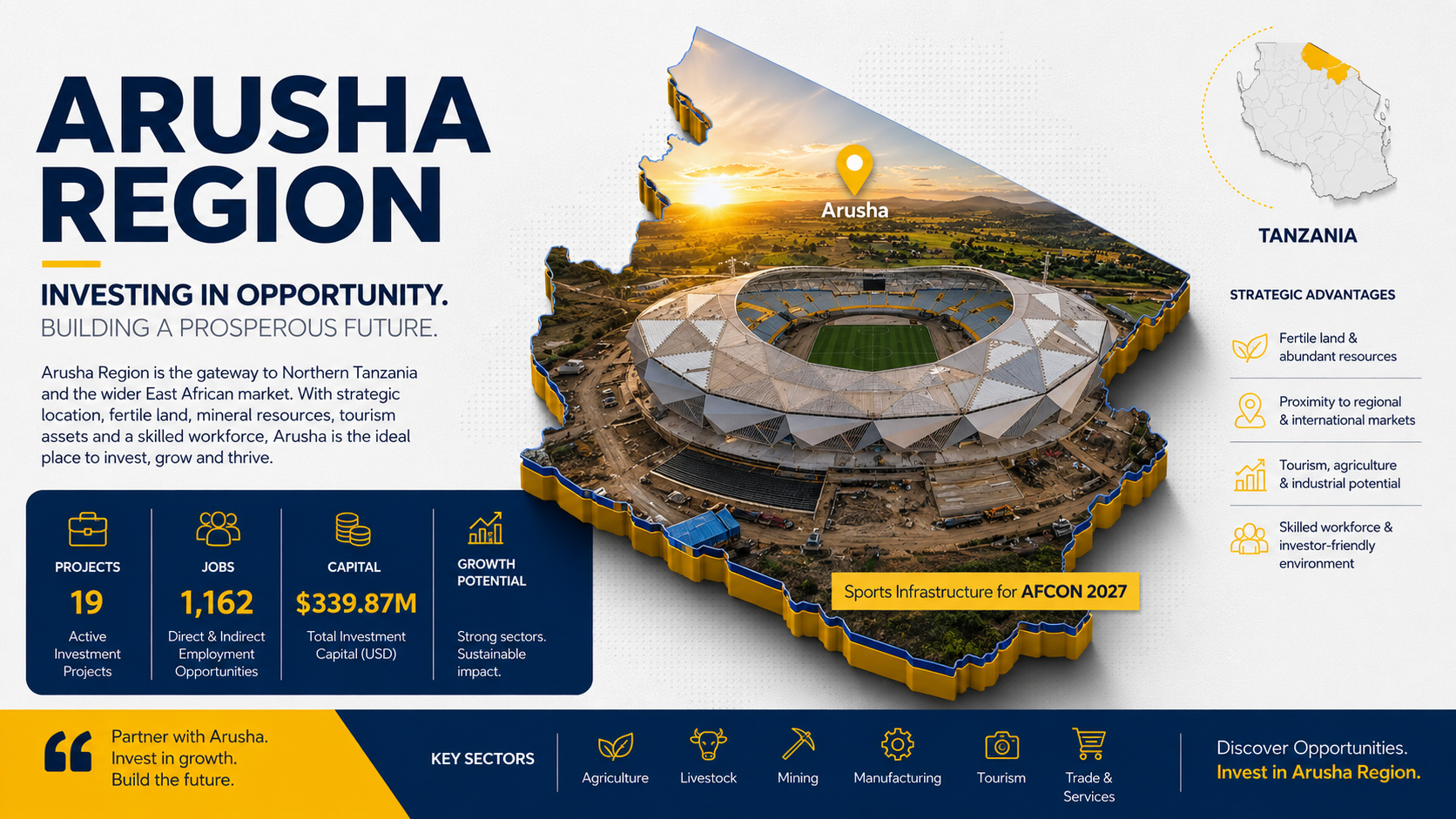
Tanzania's investment in AFCON 2027 stadium infrastructure reflects a broader economic strategy that combines urban renewal, tourism, job creation, and long-term national competitiveness rather than simply preparing for a football tournament.
--------------------------
There are moments when infrastructure becomes more than concrete and steel. It becomes an economic signal.
Tanzania's preparations for the 2027 Africa Cup of Nations (AFCON) fall squarely into that category. On the surface, the programme is about modern stadiums capable of hosting Africa's biggest football competition. Beneath that lies a more consequential ambition: using sport as a catalyst for urban transformation, tourism expansion, investment attraction and long-term economic growth.
The Government's 2026/27 Budget places stadium development within the country's wider economic transformation agenda. Among the year's strategic expenditures is TZS 302 billion dedicated to the construction of stadium infrastructure and Tanzania's participation in AFCON 2027, alongside record investments in roads, railways, electricity, education and water infrastructure.
That positioning matters.
Rather than treating sporting infrastructure as a standalone expense, the budget integrates it into the same investment framework supporting transport corridors, industrial development and public services. It reflects a philosophy that modern sports infrastructure is part of national productive capital.
The economic logic is straightforward.
Major sporting events generate immediate demand for hotels, restaurants, transport operators, construction firms, digital service providers, security companies and thousands of small businesses. Visitors consume far more than football, they purchase accommodation, food, transport, entertainment and tourism experiences.
The Government explicitly recognises these spillover effects. In the conclusion of the 2026/27 Budget Speech, the Finance Minister notes that hosting AFCON presents substantial opportunities in food services, accommodation, transportation and tourism, while complementing broader strategic investments across the economy.
That is why economists increasingly describe major sporting events as infrastructure multipliers rather than entertainment expenditures.
The more important question, however, is what remains after the tournament.
Historically, the world's most successful host nations have ensured that stadiums become anchors for wider urban development. Modern sports complexes increasingly function as mixed-use districts containing retail space, convention facilities, offices, hotels, public transport links, recreational parks and commercial real estate. Their economic value comes not from hosting a handful of matches each year but from generating activity every day.
The architectural vision emerging around Tanzania's AFCON facilities reflects this broader philosophy. Contemporary stadium developments are increasingly integrated into surrounding urban environments, creating new commercial nodes that can reshape entire districts.
The timing is equally significant.
AFCON preparations coincide with Tanzania's first year implementing the Fourth Five-Year Development Plan under Vision 2050. The broader fiscal strategy prioritises resilient growth through strategic investment, digital transformation and sustainable public finance while projecting GDP growth of 6.3% in 2026, supported by continued investment in infrastructure, tourism, agriculture, mining and services.
Sport therefore becomes one component of a much larger investment narrative.
Success will ultimately be measured not by the quality of the tournament alone, but by what follows. If the stadiums continue attracting concerts, international competitions, exhibitions, conferences and private investment while stimulating surrounding property development and tourism, AFCON 2027 will be remembered as an economic milestone as much as a sporting one.
That is the real opportunity.
Football may last ninety minutes.
Infrastructure, when planned well, creates value for generations.
Key Takeaways
- TZS 302 billion has been allocated for stadium infrastructure development and Tanzania's participation in AFCON 2027.
- AFCON infrastructure forms part of Tanzania's broader strategy of strategic public investment rather than a standalone sports project.
- The Government expects the tournament to stimulate tourism, hospitality, transport and service-sector activity while supporting long-term urban development.
- The investment aligns with Vision 2050 and the Fourth Five-Year Development Plan's objective of building a resilient, competitive and investment-driven economy.