Beyond Protocol: How the Tanzania–Egypt State Visit is Redefining Economic Diplomacy in Africa
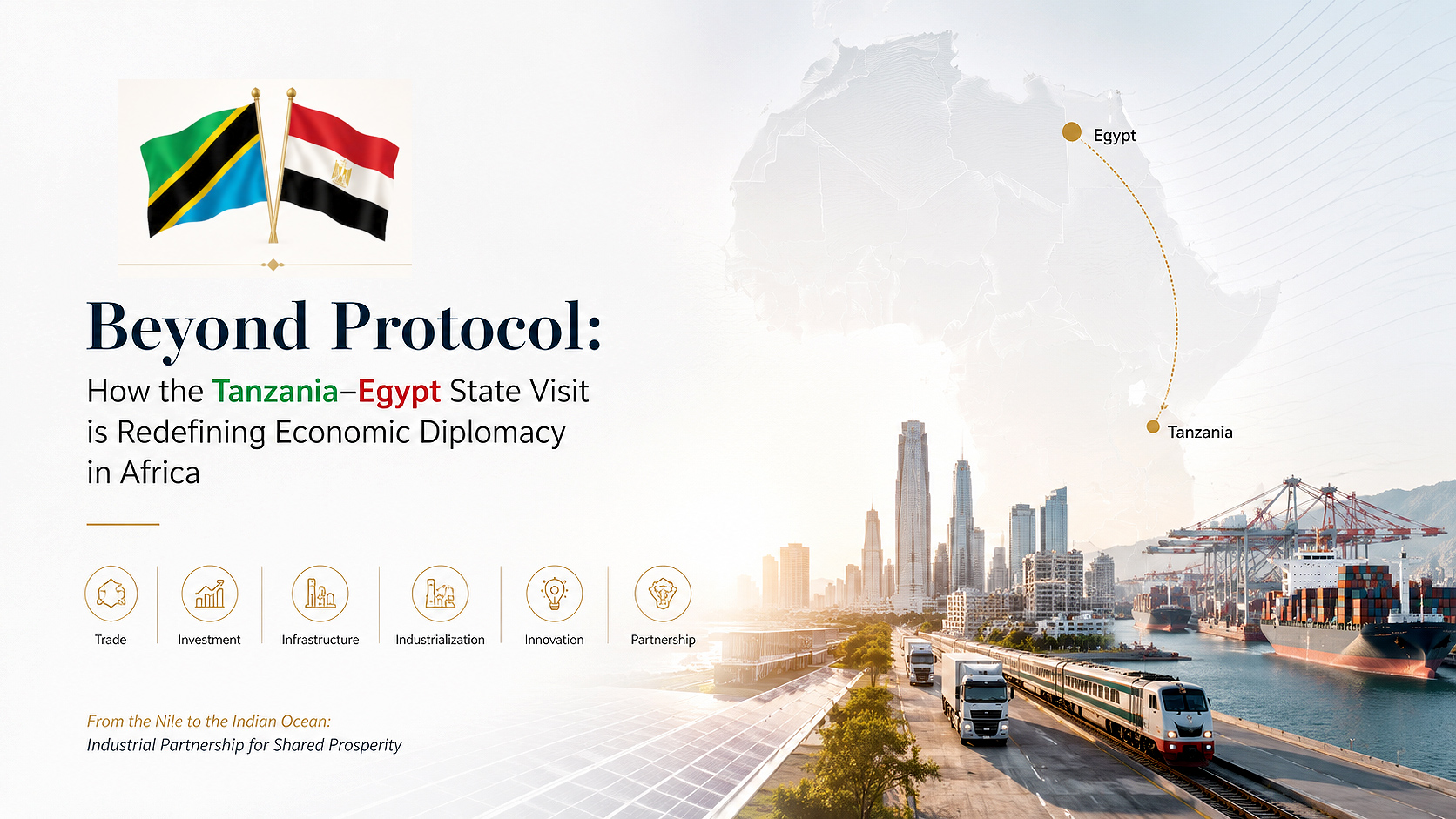
Diplomacy has always been measured through symbols.
Flags are raised. National anthems are played. State banquets are hosted. Agreements are signed beneath crystal chandeliers while cameras capture history in carefully choreographed moments.
Yet the most successful State Visits are rarely remembered because of protocol.
They are remembered because they change the trajectory of nations.
President Abdel Fattah El-Sisi's State Visit to the United Republic of Tanzania belongs firmly in that category.
Far from being a routine diplomatic engagement, the visit demonstrates how African diplomacy is increasingly becoming an instrument of industrial policy, investment mobilisation and economic transformation. The accompanying Tanzania–Egypt Business Forum illustrates this evolution by placing trade, manufacturing and private-sector partnerships at the centre of bilateral relations rather than treating them as secondary outcomes.
A Relationship Built on History, Renewed by Economics
Tanzania and Egypt share one of Africa's oldest strategic relationships.
Its foundations were laid in the early 1960s by Mwalimu Julius Nyerere and President Gamal Abdel Nasser, whose partnership helped shape the continent's liberation movements and the formation of the Organisation of African Unity.
More than sixty years later, that political solidarity has matured into institutional cooperation through the Joint Commission for Cooperation, fourteen bilateral agreements and eleven memoranda of understanding. The relationship has steadily expanded through high-level exchanges, including President El-Sisi's 2017 State Visit to Tanzania, President Samia Suluhu Hassan's official visit to Cairo in 2021, ministerial engagements in 2025 and now the 2026 State Visit that places economic diplomacy at its centre.
This progression reflects an important shift.
The relationship is no longer defined solely by shared history.
It is increasingly defined by shared industrial ambition.
The New Language of African Diplomacy
The defining feature of this State Visit is its deliberate integration of government policy with private-sector investment.
Rather than limiting discussions to intergovernmental cooperation, the Business Forum convenes a 35-member Egyptian business delegation alongside around one hundred Tanzanian companies across engineering, infrastructure, chemicals, fertilisers, food processing, pharmaceuticals, logistics and trade finance. The objective is to convert diplomatic goodwill into measurable commercial outcomes, including business-to-business agreements, institutional partnerships and follow-up mechanisms through the Joint Commission for Cooperation.
This represents modern economic diplomacy in practice.
Governments create trust.
Businesses create investment.
Markets create prosperity.
From the Julius Nyerere Hydropower Project to Industrial Ecosystems
Perhaps no project better illustrates Tanzania–Egypt cooperation than the Julius Nyerere Hydropower Project.
Constructed through the partnership between Arab Contractors and Elsewedy Electric, the 2,115 MW project has become more than an energy investment. It stands as evidence that large-scale infrastructure partnerships can create technology transfer, develop local engineering capacity and stimulate long-term industrial confidence.
The Business Forum positions this achievement not as the culmination of bilateral cooperation but as the foundation for its next phase. Elsewedy Electric's manufacturing activities in Kigamboni and the proposed expansion into industrial development illustrate how infrastructure partnerships can evolve into broader manufacturing ecosystems.
That transition is significant.
Africa needs fewer isolated megaprojects and more integrated industrial ecosystems.
Building an African Industrial Corridor
The Business Forum's theme—"From the Nile to the Indian Ocean: Industrial Partnership for Shared Prosperity"—captures a broader geopolitical vision.
Rather than viewing Tanzania and Egypt as separate regional economies, the partnership seeks to connect East Africa, North Africa, the Red Sea and Mediterranean trade routes through integrated logistics, manufacturing and investment.
One of the most ambitious proposals is the Dar–Cairo Multimodal Logistics Hub, which would connect the Port of Dar es Salaam with Egypt's ports of Sokhna and Safaga, creating a strategic corridor linking Sub-Saharan Africa with North Africa and Gulf markets. Technical discussions toward the project are already underway.
In an era when supply chains increasingly determine geopolitical influence, logistics has become diplomacy.
Turning Trade Potential into Trade Reality
Trade statistics reveal both the opportunities and the challenges.
Bilateral trade has fluctuated over recent years, with Tanzanian exports experiencing a remarkable surge in 2024 before easing again in 2025. The handbook argues that this volatility demonstrates Egyptian demand can respond rapidly when supply chains are organised, highlighting the need to transform episodic successes into sustained commercial relationships.
Current trade patterns also suggest significant room for diversification.
Tanzania exports agricultural commodities, minerals and natural-resource products, while Egypt exports industrial chemicals, fertilisers, pharmaceuticals, construction materials and engineering inputs. This complementary structure creates opportunities for deeper industrial integration rather than simple commodity exchange.
Investment Beyond Capital
Egypt has already established a substantial investment footprint in Tanzania.
According to TISEZA, Egyptian investments total nearly US$1.4 billion across 44 projects, supporting more than 4,400 jobs, with manufacturing accounting for the largest share. Thirty-two Egyptian companies have also registered interest in new investments, signalling continued confidence in Tanzania's investment climate.
Even more significant is the pipeline emerging from this visit.
Seven Expressions of Interest for industrial land within Elsewedy Industrial City at Milandizi span pharmaceuticals, chemicals, food processing, automotive components, logistics and home appliances. Together, they represent a transition from project-based cooperation toward permanent industrial production.
Economic Diplomacy as National Strategy
For Tanzania, the timing is strategic.
The Government's 2026/27 budget emphasises building economic resilience through digital transformation, strategic investment and fiscal sustainability while maintaining strong macroeconomic fundamentals. Nominal GDP reached TSh 234.1 trillion (US$91.8 billion) in 2025, real GDP grew by 5.9 per cent, inflation averaged 3.4 per cent, private-sector credit expanded by 20.2 per cent and foreign reserves remained sufficient to cover more than four months of imports.
These indicators provide the economic stability necessary for attracting long-term foreign investment.
Diplomatic engagement is therefore reinforcing, not substituting for, domestic economic reform.
Africa's Diplomacy is Becoming Commercial
Across the continent, diplomacy is changing.
Embassies are becoming investment promotion platforms.
State Visits are becoming investor conferences.
Foreign policy is increasingly measured by export growth, technology transfer, industrial investment and supply-chain integration.
The Tanzania–Egypt partnership reflects this broader transformation.
It recognises that in today's global economy, influence is built not only through political alliances but also through manufacturing capacity, logistics networks, energy security and private-sector collaboration.
The Strategic Significance
President El-Sisi's visit is therefore more than a bilateral milestone.
It offers a model for how African nations can deepen intra-African cooperation beyond political declarations.
By linking diplomacy with industrial policy, infrastructure with manufacturing, and historical friendship with commercial opportunity, Tanzania and Egypt are demonstrating that African partnerships can compete on the basis of production, innovation and shared prosperity.
That may ultimately prove to be the visit's most enduring legacy.
Not the speeches delivered.
Not the ceremonies witnessed.
But the factories built, the investments mobilised, the trade corridors opened and the industries that emerge long after the presidential motorcades have departed.