ELECTRIC MOTORCYCLES: HOW TANZANIA CAN TURN THE BODABODA SECTOR INTO A MULTI-BILLION-DOLLAR ECONOMIC ECOSYSTEM
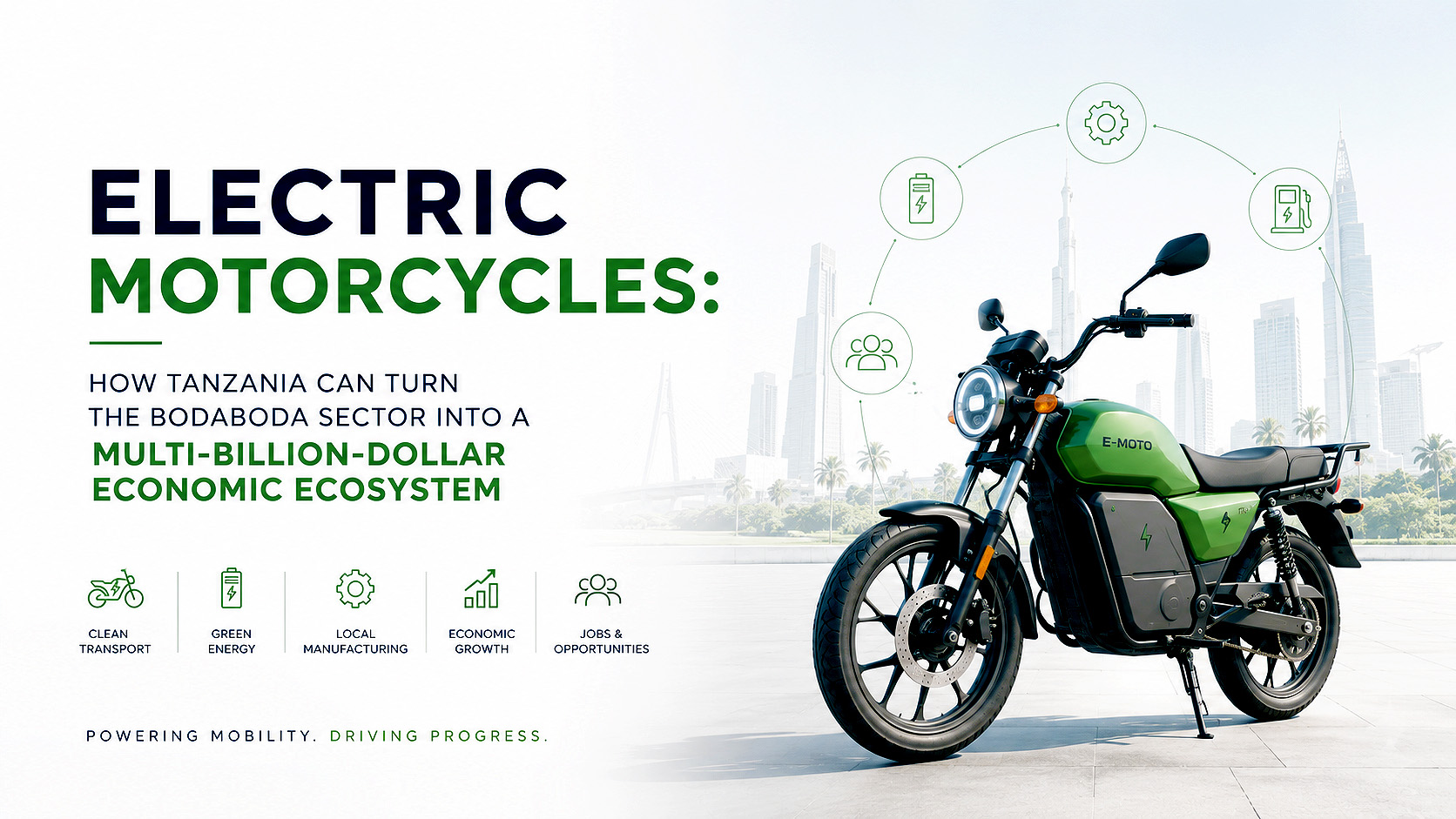
For decades, the bodaboda industry has been viewed primarily as a means of employment for young people and an affordable mode of transport. While this perception is not incorrect, it significantly underestimates the sector’s true economic potential. As the world transitions towards clean energy and sustainable mobility, Tanzania has a unique opportunity to transform its bodaboda industry from an informal transport service into one of the country’s most important industrial and economic growth engines.
The conversation should no longer be limited to replacing petrol-powered motorcycles with electric ones. Instead, Tanzania should focus on building a complete Electric Motorcycle Ecosystem, an integrated value chain that connects manufacturing, renewable energy, battery technology, digital finance, logistics, carbon markets, environmental sustainability and industrial development.
Countries that embrace this transformation early will not only reduce fuel imports but also create new industries, attract investment, generate high-quality jobs and strengthen their economic competitiveness.
Africa already has a compelling success story. Rwanda, despite its relatively small domestic market, has emerged as one of the continent’s pioneers in electric mobility. Through visionary government policies, investment incentives and close collaboration with the private sector, Rwanda has created a thriving ecosystem for electric motorcycles. Companies such as Ampersand have deployed thousands of electric motorcycles supported by an extensive battery-swapping network across Kigali, enabling riders to exchange depleted batteries for fully charged ones within minutes.
The impact has been remarkable. Riders spend significantly less on energy compared to petrol, increase their daily earnings because they lose less time charging, and benefit from lower maintenance costs. At the same time, Rwanda has attracted substantial international investment from climate finance institutions, venture capital firms and development partners seeking to support Africa’s green transport transition. Rather than simply importing electric motorcycles, Rwanda has begun developing local technical expertise, creating skilled employment and positioning itself as a regional innovation hub.
If Rwanda can achieve this with limited natural resources and a much smaller population, Tanzania possesses even greater potential. With more than 70 million people, abundant renewable energy resources, strategic ports, the Standard Gauge Railway, the Central Corridor and access to regional markets across East and Central Africa, Tanzania has every advantage needed to become the manufacturing, assembly and distribution hub for electric motorcycles in the region.
The first opportunity lies in industrialization. Rather than importing fully assembled motorcycles, Tanzania should encourage local assembly while progressively increasing domestic production of frames, seats, wiring harnesses, plastic components, batteries and electronic systems. This approach would stimulate industrial development, create thousands of skilled jobs, reduce dependence on imports and retain more value within the national economy.
Equally important is the establishment of a nationwide battery-swapping network. Instead of waiting several hours to recharge batteries, riders could exchange depleted batteries within a few minutes and continue working immediately. Battery-swapping stations would create thousands of new businesses while ensuring uninterrupted productivity for riders. Just as petrol stations became the backbone of the petroleum economy, battery-swapping stations can become the backbone of Tanzania’s electric mobility economy.
Electric motorcycles also present a strategic opportunity to strengthen Tanzania’s energy security. Every motorcycle that switches from petrol to electricity reduces demand for imported fuel while increasing demand for domestically generated electricity. This keeps more money circulating within the national economy, strengthens the electricity sector and improves the country’s balance of payments. As Tanzania continues investing in hydropower, natural gas and renewable energy, electric mobility provides a reliable domestic market for this growing electricity supply.
Financial inclusion represents another transformative opportunity. Millions of bodaboda riders operate outside the formal banking system despite generating consistent daily income. Connected electric motorcycles can generate reliable digital records through payment histories, battery subscriptions, maintenance schedules and mileage. These records can enable banks and insurance companies to provide affordable loans, health insurance, pension schemes and savings products, bringing a large informal workforce into the formal financial system.
The benefits extend beyond transportation. Electric motorcycles can revolutionize logistics by reducing delivery costs for e-commerce, agriculture, healthcare, courier services and postal operations. Farmers would transport produce more efficiently, healthcare workers could reach remote communities more easily and businesses would lower their operational costs through cheaper transport.
Perhaps the most overlooked opportunity lies in the global carbon market.
Every petrol motorcycle replaced by an electric motorcycle reduces greenhouse gas emissions. When these emission reductions are accurately measured, independently verified and certified under internationally recognized carbon standards, they become tradable carbon credits. These credits can be sold to companies and governments seeking to offset their emissions, generating a completely new source of foreign exchange for Tanzania.
Imagine Tanzania successfully transitioning one million bodaboda to electric motorcycles over the next decade. Besides reducing fuel imports and improving air quality, the country could generate a significant volume of verified carbon emission reductions. Revenue earned from carbon credits could finance additional charging stations, subsidize electric motorcycles for low-income riders, support battery recycling programmes, strengthen electricity infrastructure and attract billions of shillings in climate finance.
The environmental benefits are equally significant. Cleaner transport means lower urban air pollution, reduced greenhouse gas emissions, quieter cities and healthier communities. Meanwhile, battery recycling industries can recover valuable materials such as lithium, nickel, copper and aluminium, creating a circular economy while reducing environmental waste.
Beyond economics lies a strategic regional opportunity. Tanzania’s ports, transport corridors and expanding infrastructure position the country to become East Africa’s manufacturing and export hub for electric motorcycles, battery systems, spare parts and mobility technologies. Regional markets including Rwanda, Burundi, Uganda, Zambia, Malawi, eastern Democratic Republic of the Congo and Mozambique present enormous opportunities for Tanzanian-made products.
Achieving this vision will require bold leadership and coordinated policy. Government should introduce incentives for local manufacturing, invest in battery-swapping infrastructure, support research and innovation, expand technical education for electric vehicle technologies and create financing mechanisms that enable riders to adopt electric motorcycles at scale.
The transition to electric motorcycles should therefore be viewed not as a transport initiative but as a national industrialization strategy. It is an opportunity to create thousands of businesses, modernize manufacturing, strengthen energy independence, improve financial inclusion, generate carbon revenues and establish Tanzania as one of Africa’s leading green economies.
History consistently rewards countries that recognize transformative technologies before others do. Rwanda has already demonstrated what is possible. Tanzania possesses even greater resources, a larger market and stronger strategic advantages.
The question is no longer whether electric mobility will shape Africa’s future. The real question is whether Tanzania will seize this opportunity to lead the transformation, or watch others capture its economic benefits.
M.M