EU Action Against Tanzania- Is This Really About Governance—Or About Geopolitics?
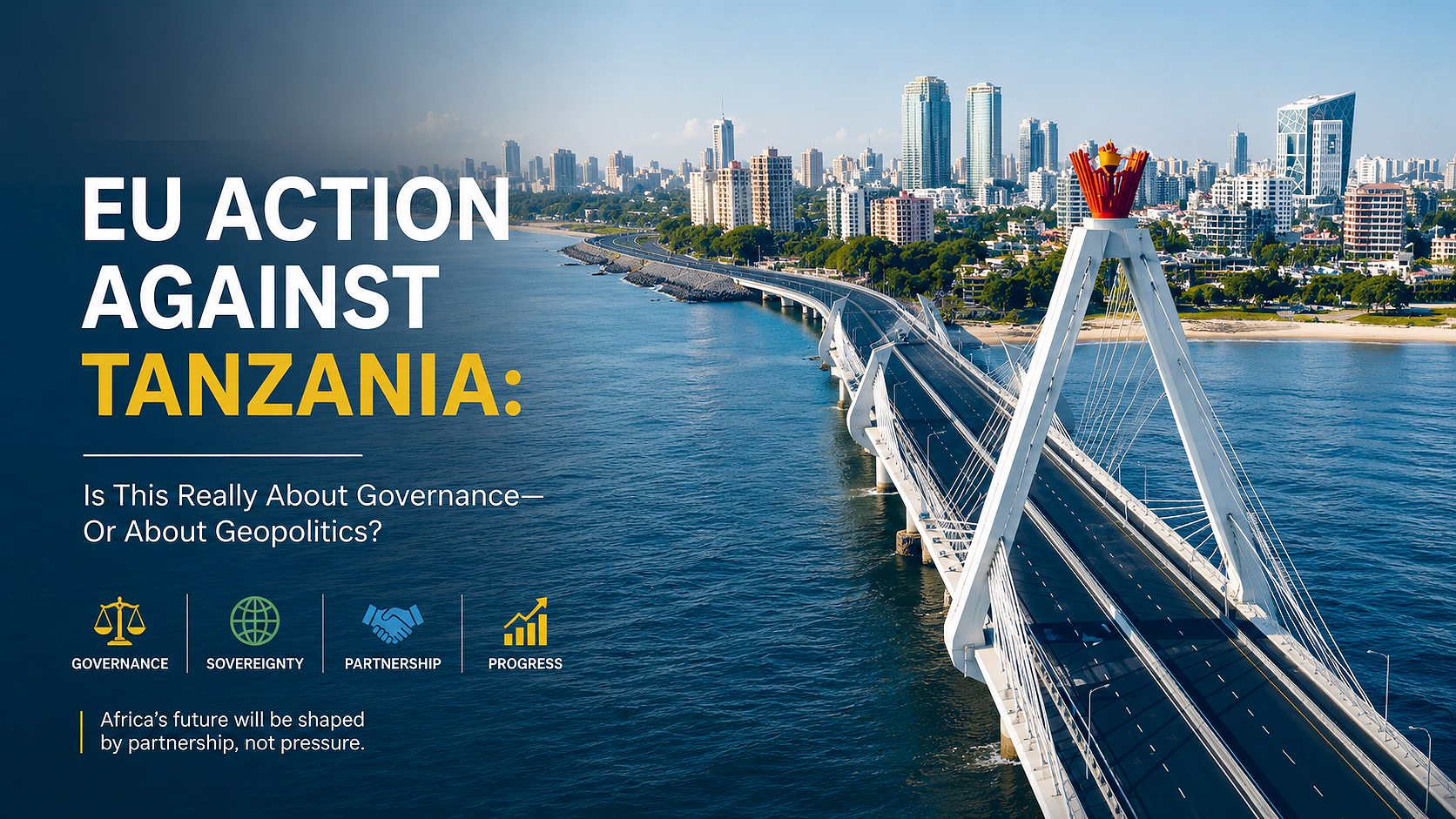
The European Parliament's latest resolution calling for the suspension of European Commission funding to Tanzania has been presented as a matter of governance, democracy and human rights. The official justification centres on concerns surrounding Tanzania's 2025 elections and broader questions regarding political freedoms. Yet beneath the language of democratic accountability lies a question increasingly being asked across Africa:
Why is Tanzania facing such intense scrutiny at precisely the moment it is pursuing a more independent foreign policy and expanding relationships beyond traditional Western partners?
The timing deserves examination.
For decades, Western governments have encouraged African nations to embrace sovereignty, economic self-reliance and diversified international partnerships. Yet when African countries begin exercising precisely that independence, the response is often less enthusiastic.
Tanzania today is no longer a peripheral player in East Africa. It is emerging as a strategic regional power. With a rapidly growing economy, major investments in transport corridors, energy infrastructure and industrial development, the country occupies an increasingly important position in the geopolitical competition now unfolding across Africa.
That competition extends far beyond Tanzania.
Across the continent, governments are deepening relations with China, India, Turkey, Gulf states and, increasingly, Russia. These relationships are not necessarily ideological. They are often transactional, driven by investment, trade, energy cooperation, agricultural support and security interests. Tanzania, like many African nations, has sought to maintain constructive relations with all major powers rather than aligning exclusively with any geopolitical bloc.
This reflects a long-standing principle of Tanzanian foreign policy dating back to the era of Julius Nyerere: strategic non-alignment.
The problem is that the international environment has changed.
Since the outbreak of the Russia-Ukraine war, global politics has increasingly been viewed through the lens of competing camps. Countries are often expected to demonstrate loyalty rather than neutrality. For many African states, however, neutrality is not indecision, it is national interest.
Tanzania's position has generally been consistent. It has avoided becoming a proxy in great-power competition while maintaining diplomatic engagement with multiple partners. Yet such independence can sometimes be interpreted in Western capitals as insufficient alignment.
This raises an uncomfortable question.
Would Tanzania be facing the same level of pressure if its foreign policy positions more closely mirrored those of Brussels?
The European Parliament's resolution may genuinely reflect concerns among lawmakers regarding governance issues. But it is equally difficult to ignore the broader geopolitical context in which it emerges.
After all, the international system has never applied standards uniformly.
Around the world, strategic allies frequently receive diplomatic patience that is denied to countries pursuing more independent paths. Nations with far worse governance records often escape comparable levels of scrutiny because they occupy favourable geopolitical positions. Meanwhile, countries that seek strategic autonomy can find themselves subject to heightened criticism.
Africa has observed this pattern before.
What makes the Tanzanian case particularly noteworthy is that the country is simultaneously becoming less dependent on external assistance. The government's latest budget emphasises domestic resource mobilisation, industrialisation, digital transformation and reduced reliance on foreign aid. Economic growth remains robust, inflation is contained, major infrastructure projects are nearing completion, and public investment continues to expand.
In short, Tanzania is becoming harder to influence through traditional development-finance mechanisms.
That reality may not be the cause of the European Parliament's concerns. But it is undoubtedly part of the wider strategic environment.
The deeper issue at stake is not simply Tanzania. It is Africa's place in a changing world.
Many African governments increasingly reject the notion that international partnerships must come with geopolitical conditions attached. They seek relationships based on mutual interests rather than ideological alignment. They want access to European markets, Chinese infrastructure, Gulf capital, Indian technology and Russian cooperation, without being forced to choose sides.
This is not anti-Westernism.
It is sovereignty.
The challenge for Europe is recognising that Africa's growing confidence inevitably means a more independent foreign policy. Countries that become economically stronger will naturally exercise greater strategic choice.
The challenge for Tanzania, meanwhile, is to continue strengthening democratic institutions and governance standards while firmly defending its right to conduct foreign relations according to its own national interests.
Ultimately, the debate is bigger than one parliamentary resolution.
It is about whether African nations will be permitted to engage with the world on their own terms.
Tanzania appears increasingly determined to do exactly that.
And perhaps that is what some in Brussels find most difficult to accept.
The real question is not whether Tanzania should be subject to scrutiny, every democracy should welcome accountability. The question is whether the standards being applied are consistent, objective and free from geopolitical considerations. As Tanzania expands its global partnerships, strengthens its economic independence and pursues a foreign policy rooted in national interest rather than bloc politics, it is inevitable that some external actors will view this growing autonomy with discomfort.
Yet Tanzania's trajectory is increasingly defined by confidence rather than dependence. The country is investing in infrastructure, embracing digital transformation, expanding regional influence and building a more resilient economy capable of standing on its own foundations. In a rapidly changing multipolar world, Tanzania is asserting a principle that resonates across Africa: nations should be free to engage with all partners, East and West alike, without facing political pressure for exercising sovereign choices.
Whether the European Parliament's actions are driven purely by governance concerns or influenced by broader strategic calculations will remain a matter of debate. What is beyond debate, however, is that Tanzania's future will ultimately be determined in Dodoma, not Brussels. The country's success will depend on its ability to continue strengthening institutions, delivering prosperity and defending its sovereign right to chart its own course.
Tanzania is not choosing sides. It is choosing itself.