IFC’s London Shilling Bond Gives Tanzania’s Enterprise Economy a Global Opening
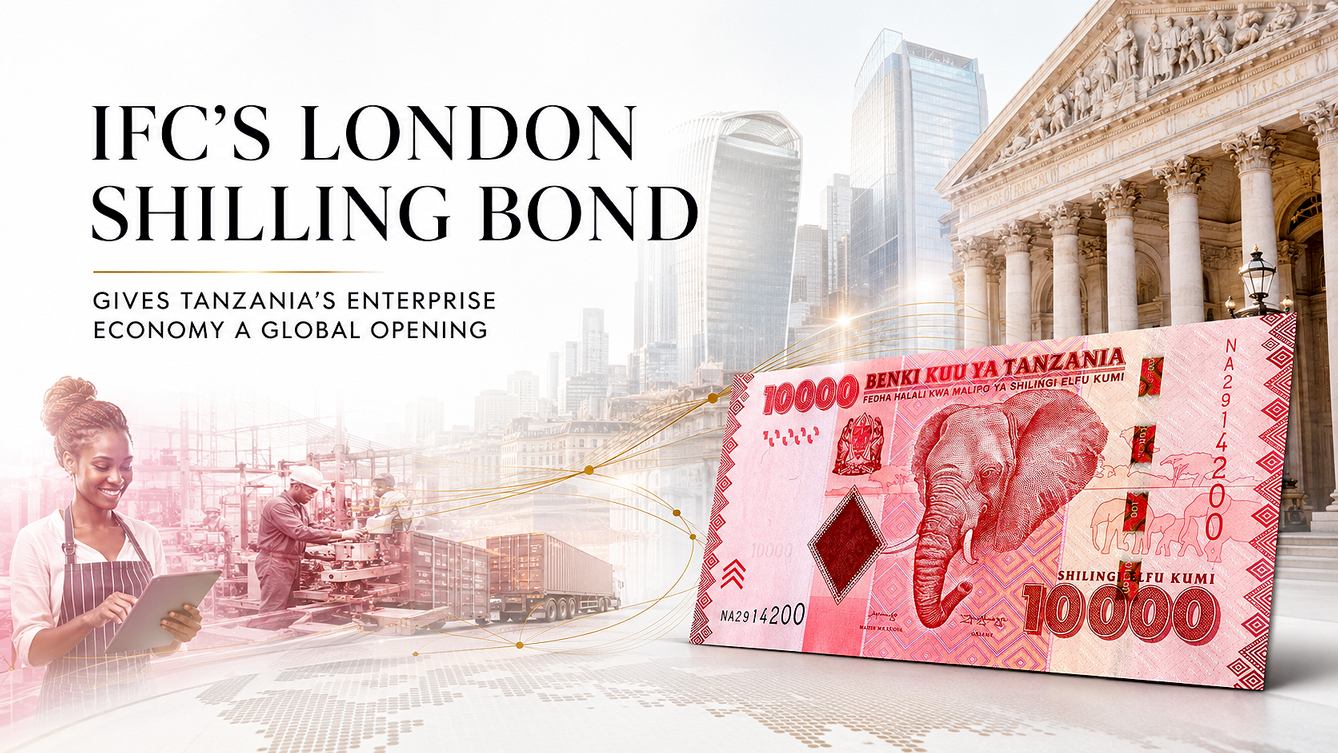
The landmark transaction connects international capital with five-year local-currency financing for NMB Bank’s small-business portfolio, without adding to Tanzania’s sovereign debt.
Tanzania’s shilling has crossed an important financial frontier.
The International Finance Corporation has listed a TSh265.2 billion bond, equivalent to approximately US$100 million, on the London Stock Exchange, opening a new international channel through which global capital can support Tanzanian businesses in the currency they earn.
The five-year instrument carries a 7.60% coupon and matures in June 2031. Placed by Goldman Sachs International, it represents the first offshore shilling-denominated bond of its kind and gives international investors exposure to Tanzania’s currency through IFC, the World Bank Group’s private-sector development institution.
More important than the symbolism of the London listing is where the money is intended to go. IFC will use the proceeds to support an equivalent local-currency loan of up to US$100 million to NMB Bank. The facility, which includes a two-year grace period, will allow one of Tanzania’s largest commercial banks to expand longer-term lending to micro, small and medium-sized enterprises.
The transaction is therefore not simply a bond-market milestone. It is an attempt to connect international investment capital with the businesses that form the productive foundation of Tanzania’s economy.
A vote of confidence in the shilling
Finance Minister Ambassador Khamis Mussa Omar officiated at the listing, presenting it as part of Tanzania’s wider effort to deepen engagement with international investors and mobilise capital for the ambitions contained in Development Vision 2050.
That ambition is increasingly visible across the economy. Tanzania is investing heavily in railways, ports, energy, aviation and regional trade corridors while seeking to expand manufacturing, formalise businesses and increase private-sector participation. A growing economy will require more than public infrastructure, however. It will also need deeper financial markets capable of providing companies with patient capital in local currency.
The London bond contributes to that process.
For international investors, it establishes a professionally structured route into a market that has traditionally been difficult to access from offshore financial centres. For Tanzania, it demonstrates that the shilling can support an internationally placed, medium-term instrument when the transaction has strong credit sponsorship and a clearly defined development purpose.
It does not yet create a fully developed offshore market for the currency. But every market begins with a transaction that establishes precedent.
Removing an avoidable business risk
The structure addresses one of the most persistent financing problems confronting companies in developing economies: the mismatch between the currency in which they earn and the currency in which they borrow.
Most Tanzanian small businesses receive nearly all their income in shillings. Borrowing in dollars may appear attractive when foreign-currency interest rates are lower, but it can quietly convert an ordinary business investment into a bet on the exchange rate.
If the shilling depreciates, the local-currency cost of servicing dollar-denominated debt rises, even when sales, productivity and operating performance remain strong. A profitable factory, transport company or agricultural processor can consequently encounter financial distress for reasons unrelated to the quality of its underlying business.
Shilling financing reduces that mismatch. Revenues and repayments move in the same currency, making cash flows more predictable and allowing entrepreneurs to concentrate on production, employment and market expansion rather than currency speculation.
This matters especially for MSMEs, which rarely possess the financial instruments, scale or specialist expertise needed to hedge foreign-exchange exposure.
Making longer-term lending possible
Local-currency credit is available in Tanzania, but longer tenors remain more difficult to secure. Banks must balance the demand for investment finance against funding costs, liquidity constraints and the higher perceived risks associated with smaller enterprises.
The IFC arrangement seeks to loosen those constraints.
Up to US$40 million of the facility is expected to benefit from first-loss credit enhancement under the IDA20 Private Sector Window’s MSME Finance Platform. The remaining US$60 million will be processed on a standalone basis.
The credit-enhancement mechanism absorbs an agreed portion of potential initial losses, making it more viable to extend finance into market segments that commercial lenders might otherwise serve cautiously. It is not a subsidy for poor business decisions. Properly deployed, it is a risk-sharing mechanism intended to encourage lending to viable enterprises that lack long credit histories, substantial collateral or access to longer-term funding.
NMB is expected to use the proceeds to expand its MSME portfolio, with 20% targeted at women-owned businesses. At the facility’s full US$100 million equivalent, this would represent approximately US$20 million in targeted financing, subject to the exchange rate and the actual pattern of loan deployment.
That allocation is economically significant. Women-owned enterprises are prominent across Tanzanian commerce, agriculture, services and light manufacturing, yet they frequently encounter greater collateral and financing constraints. Reaching them with appropriately structured credit could increase business formalisation, household incomes and employment simultaneously.
Not another government debt
The identity of the issuer is crucial.
This bond was issued by IFC, not by the Government of Tanzania. The transaction therefore does not constitute sovereign borrowing, does not directly finance the national budget and should not be compared with a Tanzanian Eurobond.
Investors are acquiring exposure to a shilling-denominated instrument backed by IFC’s credit. IFC, in turn, is linking the funds to a senior loan for NMB Bank, which will channel the financing into private-sector lending.
The distinction matters because Tanzania is implementing a TSh62.33 trillion budget for the 2026/27 financial year, including planned new borrowing of TSh15.54 trillion. Of this, TSh6.56 trillion is expected from domestic sources, TSh6.55 trillion from external concessional loans and TSh2.43 trillion from external commercial financing.
The London-listed IFC bond sits outside these sovereign financing plans. Rather than increasing the government’s direct debt burden, it expands the financial architecture available to Tanzania’s private sector.
That is precisely the type of capital-market innovation Tanzania will need as it attempts to finance faster growth without placing every major development requirement on the sovereign balance sheet.
A stronger economic proposition
The bond arrives at a favourable point in Tanzania’s economic development story.
The country combines political stability, a population of more than 60 million, extensive natural resources and access to the Indian Ocean with a strategic position serving several landlocked regional economies. Major investments in the standard-gauge railway, ports, electricity, aviation and cross-border corridors are gradually lowering the physical barriers to commerce.
The next challenge is financial: ensuring that businesses can use this infrastructure to expand production, trade and employment.
MSMEs account for much of Tanzania’s commercial activity, but many remain constrained by limited collateral, short loan maturities and financing costs that make investment difficult. Better roads and ports can lower the cost of moving goods; reliable electricity can support manufacturing; digital infrastructure can widen market access. Yet companies must still finance machinery, inventory, technology and working capital before those improvements translate into higher output.
The IFC–NMB facility helps bridge that gap. It aligns infrastructure-led growth with enterprise-level financing, bringing international capital closer to the firms expected to convert Tanzania’s public investments into private production.
The real work begins after London
The listing ceremony offers international visibility, but the success of the transaction will ultimately be measured in Tanzania rather than Britain.
The key questions are practical. How many qualifying enterprises receive financing? What sectors attract the funds? Are loan maturities long enough to support productive investment rather than merely short-term consumption? How much capital reaches businesses outside the largest urban centres? Do women-owned enterprises receive the intended allocation? And how many sustainable jobs result?
Reports associated with the transaction have cited the potential creation or support of between 13,000 and 20,000 jobs. That would be a meaningful outcome, but it will require transparent measurement distinguishing projected employment from jobs actually created or retained.
Pricing must also be interpreted carefully. The bond’s 7.60% coupon represents the return paid to its investors. It is not necessarily NMB’s final cost of funding. Fees, currency arrangements, credit enhancement and the terms of IFC’s loan will collectively determine the economics of the facility, and those details have not been disclosed fully.
Nor should one successful issue be mistaken for a complete offshore shilling market. A durable market would require repeat transactions, participation from a wider group of investors and issuers, greater liquidity and enough instruments across different maturities to begin forming a credible yield curve.
Still, first transactions matter. They establish documentation, investor familiarity, pricing references and confidence that can reduce the difficulty of subsequent issuances.
From precedent to platform
The broader opportunity is to turn this bond from an isolated milestone into a financing platform.
If NMB deploys the proceeds successfully and the underlying loans perform well, the transaction could strengthen the case for future shilling-denominated instruments supporting sectors such as agriculture, affordable housing, renewable energy, logistics and industrial development. Other Tanzanian banks and large companies may eventually find it easier to diversify their funding beyond conventional domestic deposits and foreign-currency borrowing.
That would mark an important evolution in Tanzania’s financial development: international capital entering the economy in ways better aligned with domestic revenues and productive investment.
The signal from London is encouraging. A globally recognised development institution has issued a five-year instrument in Tanzania’s currency, and the proceeds are being directed toward the enterprises that generate employment, strengthen supply chains and broaden the country’s productive base.
But the investable story does not end when a bond is listed.
It begins when the money reaches Tanzanian businesses, when those businesses invest without assuming unnecessary currency risk, and when their repayment records provide the evidence needed to bring the next group of international investors to the shilling.