Is Iran Preparing to Permanently Restrict the Strait of Hormuz?
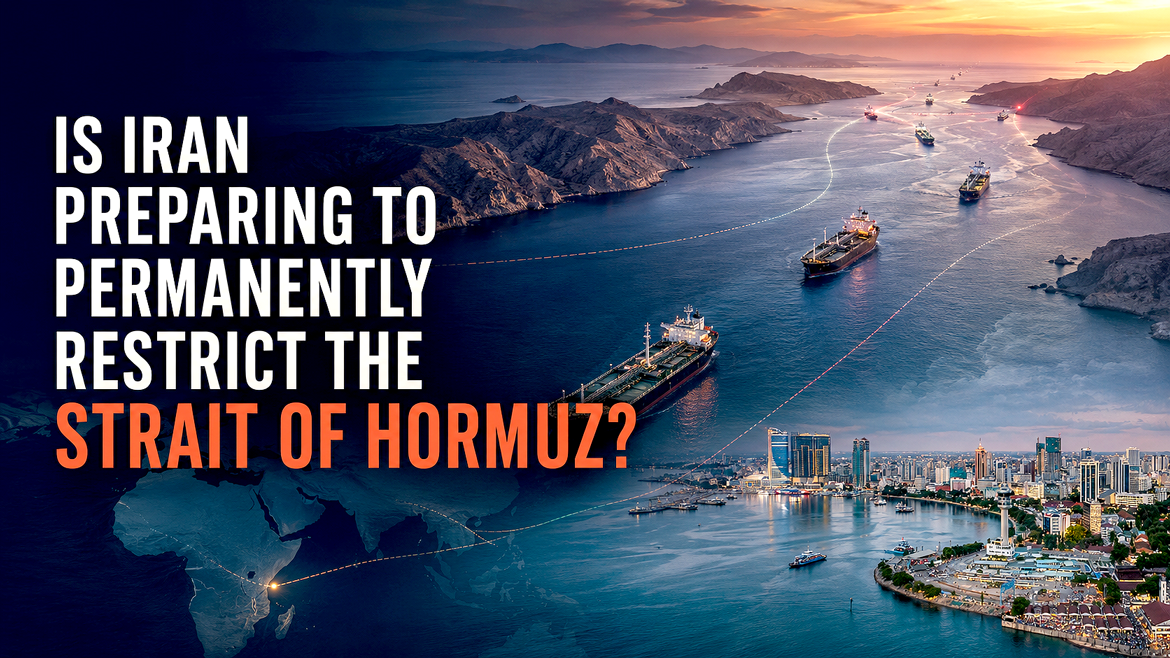
What an escalating maritime crisis means for global energy markets, and why Tanzania must prepare now
Iran’s proposed restrictions would transform disruption in the world’s most important oil chokepoint from a temporary military risk into a potentially enduring feature of global trade. For Tanzania, the danger extends beyond fuel prices, but so does the strategic opportunity.
Global energy markets are confronting a more troubling question than whether the Strait of Hormuz will reopen: whether it will ever return to its former operating order.
Diplomatic signals remain contradictory. United States President Donald Trump has suggested that an agreement with Iran is close, while Tehran continues to attach conditions to the restoration of normal maritime traffic. At the same time, Iran’s Parliament is considering legislation that could formalise restrictions on vessels associated with the United States, Israel and other countries classified by Tehran as hostile.
The legislation does not yet amount to a permanent closure of Hormuz. Nor does its introduction guarantee that it will be enacted or enforced. But it represents a potentially significant change in the architecture of the crisis: Iran may be seeking to convert temporary wartime leverage into a lasting system of selective maritime control.
That distinction matters enormously.
A temporary disruption can be priced as an emergency. A permanent or politically conditional restriction must be treated as a structural change to the global energy system.
With ICE Brent crude trading at approximately US$83 per barrel, the market appears to be balancing expectations of diplomatic progress against the possibility of renewed escalation. Yet the relatively contained headline price may understate the deeper transformation already taking place across shipping, refining, sanctions enforcement and national energy-security planning.
From temporary closure to permanent leverage
Iranian lawmakers are reviewing an 11-article proposal that would create a framework for regulating security, navigation and economic activity in the Strait of Hormuz and the Persian Gulf. Reported provisions include restrictions on vessels connected to hostile governments, compensation requirements and financial penalties for violations.
The proposal is especially consequential because Hormuz is not an ordinary maritime passage. It is the principal route through which Gulf producers move vast quantities of crude oil, refined products and liquefied natural gas to international markets. Around one-fifth of global petroleum consumption traditionally passes through the strait, making it the most strategically important energy chokepoint in the world.
A blanket and indefinite closure would also damage Iran’s own economy and relationships with regional trading partners, making such an outcome costly for Tehran. Selective restrictions, however, could provide Iran with a more flexible instrument: allowing some vessels to pass while imposing costs, delays or prohibitions on others.
That would create a two-tier maritime system in which access depended increasingly on nationality, ownership, cargo origin, insurance arrangements and political alignment.
Such a regime would be difficult to administer and internationally contested. It could also increase the risk of miscalculation by forcing shipping companies to navigate not only physical hazards but an evolving network of political classifications and enforcement rules.
The Iranian Parliament is considering the proposed restrictions while Tehran and Oman pursue a parallel diplomatic track. The two countries have reportedly reached an understanding on the coordinates of a possible navigation corridor through Hormuz. However, Iranian officials have cautioned that important details remain unresolved and that the route alone would not guarantee maritime security. The provisional negotiations envisage separate routes through Iranian and Omani waters, but final political approval remains uncertain.
The competing initiatives reveal the central tension in Iran’s strategy. Tehran wants the commercial and diplomatic benefits of restored traffic while retaining control over one of its most powerful geopolitical bargaining instruments.
For oil markets, therefore, an agreement on coordinates would not necessarily mark the end of the crisis. It might instead inaugurate a more managed, and more politicised, system of passage.
Saudi pricing reflects a distorted Gulf market
Saudi Arabia is already adapting to changed conditions.
Saudi Aramco has reduced the September official selling-price differential for its flagship Arab Light crude to Asian customers by US$0.50 per barrel, placing it at US$2 below the Oman–Dubai benchmark. The discount is reportedly its widest since 2020. At the same time, the company increased the differentials for Arab Medium and Arab Heavy by US$1.25 per barrel. The contrasting adjustments point to changing availability across crude grades, rather than a uniform weakening in demand.
These prices are more than routine commercial revisions. They indicate how refiners and producers are responding to disruptions in crude flows, variations in grade availability and uncertainty about the speed at which Gulf exports can normalise.
A diplomatic breakthrough could release additional barrels and weaken the geopolitical premium embedded in crude prices. A breakdown in negotiations could reverse that calculation abruptly, pushing prices, tanker rates and insurance costs higher.
This is why an oil price of US$83 per barrel should not be interpreted as evidence that the danger has passed. It represents a market probability weighted between two sharply different outcomes.
An energy crisis spreading far beyond the Gulf
The pressure on energy infrastructure is not confined to Hormuz.
Russia has authorised the production, import and sale of lower-standard Euro-2, Euro-3 and Euro-4 gasoline until July 2027 as the country confronts severe damage to its refining system. Estimates of the disruption vary, but some assessments suggest that around 40% of refining capacity may have been unavailable at points during the crisis. Crude processing reportedly fell to approximately 3.9 million barrels per day in July, its lowest level in more than two decades.
Moscow’s decision illustrates an uncomfortable reality: possessing large oil reserves does not guarantee fuel security if refining plants, transport infrastructure and distribution networks cannot operate reliably.
Britain, meanwhile, has expanded sanctions against Russia’s financial and maritime networks, targeting banks, tankers and companies associated with strategic mineral imports. The widening campaign demonstrates how financial restrictions, shipping controls and asset designations have become extensions of energy warfare.
China is moving in the opposite direction. After restricting refined-product exports to protect domestic supply, Beijing has relaxed export controls for a second consecutive month. Refiners received temporary approval to ship approximately 2.7 million tonnes of fuel to markets outside Hong Kong and Macau during August, while total exports, including bonded jet fuel and Hong Kong deliveries, could reach 3.6–3.7 million tonnes. Chinese refinery throughput was estimated at nearly 13 million barrels per day in July.
If Gulf supplies remain constrained, these additional Chinese volumes could become increasingly important to petroleum-importing economies. But substituting one concentrated source for another would not eliminate vulnerability. It would merely relocate it.
The strategic answer is diversification.
Infrastructure is becoming a form of insurance
Elsewhere, governments are rediscovering the geopolitical value of alternative infrastructure.
Iraq and Syria are considering the reconstruction of the Kirkuk–Baniyas pipeline, potentially restoring an export route capable of carrying an estimated 1.5–2 million barrels per day towards the Mediterranean by 2029. Hormuz-related disruption has strengthened the case for the project because Iraq remains heavily dependent on southern Gulf terminals.
The pipeline would not merely transport crude. It would provide strategic redundancy: the ability to move energy through another corridor when the primary route is disrupted.
Europe is facing a different form of infrastructure vulnerability. Extremely low water levels around Kaub on Germany’s Rhine reportedly reduced navigable depth to approximately 17 centimetres, forcing some vessels to operate at only a fraction of normal capacity. Inland tanker freight rates consequently rose to around €160 per tonne.
In the United States, however, Henry Hub natural-gas futures fell to approximately US$2.64 per million British thermal units after inventories increased by 33 billion cubic feet. Strong production and weaker demand from LNG export facilities outweighed seasonal consumption.
Together, these developments demonstrate that there is no single global energy market experience. One region may face scarcity while another confronts surplus. The decisive factor is increasingly whether infrastructure can connect available supply with markets that need it.
Tanzania’s exposure is immediate
For Tanzania, the Hormuz crisis is not a distant geopolitical contest. It is a potential transmission channel for inflation.
The country remains dependent on imported petroleum products. Sustained instability in the Gulf can therefore increase the landed cost of fuel through several mechanisms: higher international product prices, rising tanker charges, more expensive insurance, longer delivery schedules and greater demand for working capital.
Those costs would not stop at the filling station. They would move through freight transport, agriculture, construction, aviation, manufacturing and electricity systems that rely on liquid fuels. Higher import costs could also intensify demand for foreign currency, place pressure on the balance of payments and complicate efforts to contain inflation.
The threat is consequently broader than a rise in petrol or diesel prices. It is a macroeconomic risk.
Tanzania should strengthen fuel-price scenario planning around multiple crude and freight assumptions, including a renewed escalation that drives Brent significantly above US$83 per barrel. Policymakers should also model the combined effects of higher shipping costs, insurance premiums and currency pressure, not merely changes in the benchmark oil price.
From vulnerable importer to regional energy platform
The crisis also presents Tanzania with a strategic opening.
Procurement should become more geographically diversified. Gulf suppliers will remain essential, but competitive cargoes from India, China and other Asian refining centres deserve systematic consideration. Long-term supply arrangements should be complemented by flexible purchasing mechanisms capable of responding quickly when trade flows change.
Diversification, however, is only the first layer of resilience. The deeper opportunity lies in infrastructure.
Tanzania occupies an advantageous position on the Indian Ocean and provides maritime access to several land-linked economies in East and Central Africa. The ports of Dar es Salaam and Tanga, combined with road, rail and pipeline networks serving Rwanda, Burundi, Uganda, Zambia and the Democratic Republic of Congo, could support a much larger regional petroleum ecosystem.
With sufficient investment, Tanzania could evolve from being primarily an end-market importer into a petroleum-storage, trading, blending, logistics and distribution platform.
That ambition would require expanded coastal storage, efficient offloading facilities, stronger inland-distribution networks, transparent access arrangements and strategically located reserves. Improvements to the Central Corridor would allow petroleum infrastructure to serve not only domestic consumption but regional demand.
Strategic reserves should be treated as economic-security infrastructure rather than as passive emergency stock. Their design should consider product composition, regional demand, storage rotation, financing and the speed at which fuel can be moved to consumption centres during a disruption.
Private capital could play an important role in financing terminals, storage facilities and distribution infrastructure, provided that the regulatory framework is predictable and national-security objectives are clearly protected.
Hormuz is a warning Tanzania should use
It remains uncertain whether Iran will enact or enforce permanent restrictions in the Strait of Hormuz. The proposed legislation may become a bargaining tool, a basis for selective controls or part of a wider maritime settlement. A complete and lasting closure remains an extreme scenario rather than an inevitable outcome.
But waiting for certainty would miss the central lesson.
The world is entering an era in which energy security depends not only on how much oil or gas exists, but on whether it can be refined, financed, insured and transported through politically contested infrastructure. Supply diversification, strategic storage and alternative logistics corridors are becoming as important as production itself.
For Tanzania, Hormuz should therefore be understood as both a warning and an invitation to act. Strengthening petroleum reserves, widening the country’s supplier base, modernising Dar es Salaam and Tanga’s energy infrastructure and expanding regional transport connections would provide protection against future shocks while creating new commercial value.
The countries best positioned for the next energy crisis will not necessarily be those with the most resources. They will be those that build the most resilient routes to reach them.