Maritime Security Is Becoming the New Currency of Global Oil Markets Edited
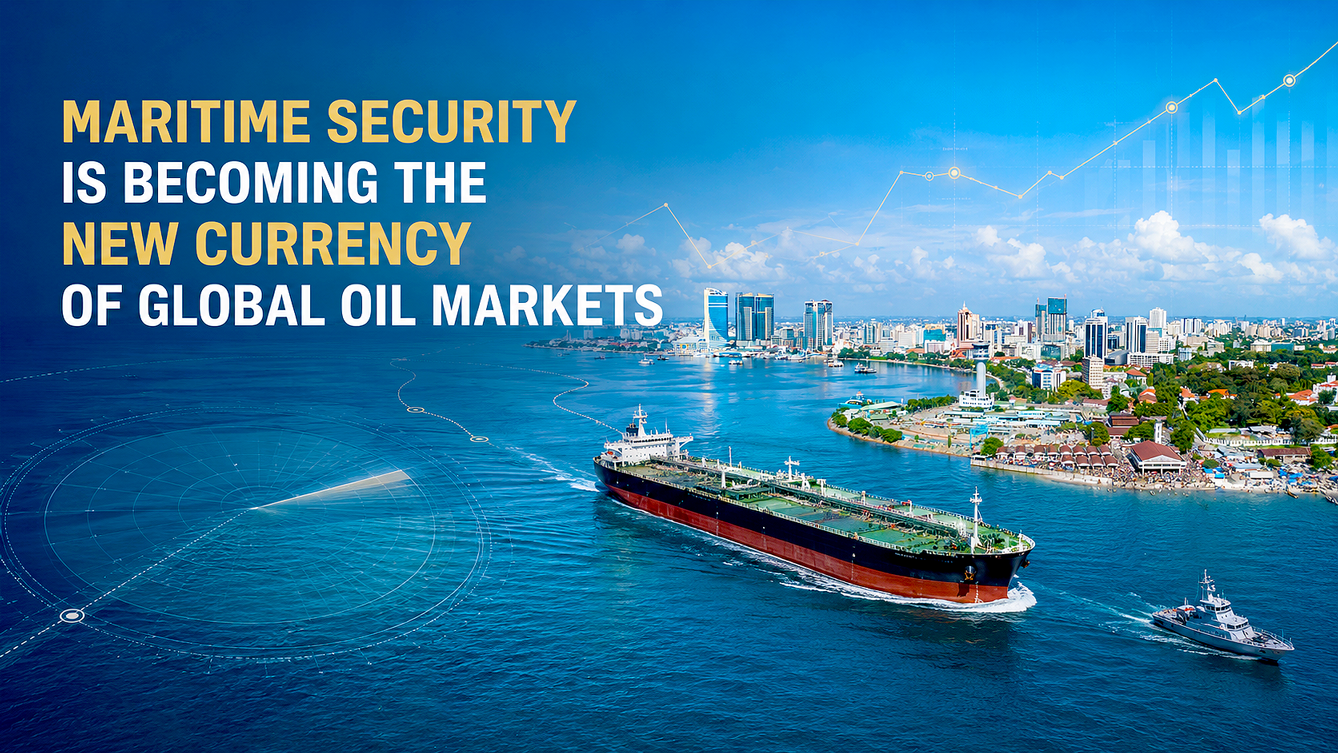
Saudi Arabia’s Red Sea coalition signals a strategic shift: energy power will increasingly belong not only to countries that produce oil, but also to those capable of protecting the routes through which it moves.
By Energy Market Analysis
The global oil market is entering an era in which the security of a barrel may matter almost as much as its availability.
Brent crude recorded a sharp weekly correction after signs of limited de-escalation in the conflict involving Iran. Yet prices remained supported near $90 a barrel at the end of July, well above levels that would ordinarily be expected from conventional assessments of production, inventories and demand. The difference is a geopolitical premium attached not merely to the possibility that oil could be taken out of the market, but to the growing risk that it may be unable to reach consumers safely.
This is the defining shift in today’s energy economy. Oil prices are no longer responding solely to OPEC+ production decisions, Chinese consumption or American inventories. They are increasingly being shaped by naval deployments, drone capabilities, insurance costs, vessel availability and the credibility of governments tasked with protecting the world’s maritime arteries.
In effect, maritime security is becoming a new currency of the global oil market.
Saudi Arabia moves from oil supplier to security guarantor
The most consequential development of the week was Saudi Arabia’s announcement of a 14-country maritime defence coalition intended to protect navigation across the Red Sea, the Bab el-Mandeb Strait and the Gulf of Aden. Riyadh will lead the initiative, placing the kingdom at the centre of a wider effort to defend international shipping from Houthi attacks and restore confidence along one of the world’s most strategically important trade corridors. Al Jazeera
The coalition represents more than a military response. It signals an evolution in Saudi Arabia’s geopolitical role.
For decades, the kingdom’s international importance rested principally on its production capacity, vast reserves and ability to stabilise oil markets through spare supply. The Red Sea initiative adds another dimension: Saudi Arabia is positioning itself as a guarantor of the infrastructure and maritime routes on which global energy trade depends.
That distinction matters. Oil supply has little stabilising value if tankers cannot sail, insurers withdraw coverage or freight costs make delivery prohibitively expensive. By protecting commercial vessels, the coalition could gradually reduce war-risk premiums, improve tanker availability and restore confidence among shipowners. Its effectiveness, however, will depend on intelligence-sharing, operational coordination and whether participating countries are prepared to enforce deterrence rather than merely provide a visible naval presence.
The initiative also reflects Saudi Arabia’s strategic exposure. If instability restricts both the Strait of Hormuz and the southern Red Sea, the kingdom’s options for moving crude to international markets narrow considerably. Defending the Bab el-Mandeb is therefore not only a contribution to global trade. It is a central component of Saudi Arabia’s own economic security.
Hormuz remains the market’s pressure point
Despite the significance of the Saudi-led coalition, the Strait of Hormuz remains the world’s most sensitive energy chokepoint. Roughly one-fifth of global petroleum consumption passes through or originates from the Gulf systems dependent on the strait, giving even a limited disruption the capacity to move prices, freight markets and inflation expectations across the world.
Reports that Iran’s Islamic Revolutionary Guard Corps had compelled tankers to turn back reinforced concerns over the reliability of passage. Tehran’s rejection of proposals for jointly managed regional arrangements added to the uncertainty, while the absence of a durable diplomatic settlement left traders unable to price in a credible return to normal operations.
Commercial movement did not disappear entirely. The reported passage of QatarEnergy’s Al Areesh, carrying liquefied natural gas to Pakistan, demonstrated that carefully negotiated transits remain possible. But selective passage is not the same as freedom of navigation. If each voyage requires diplomatic intervention or exceptional security arrangements, the strait is technically open but commercially impaired.
This explains why oil retained a substantial risk premium even after the late-July sell-off. Brent fell sharply as markets reacted to a pause in military escalation, reaching roughly $90 a barrel on July 27. The decline reflected relief, not resolution. IG
The market’s message was clear: a ceasefire can reduce prices quickly, but only secure and predictable shipping can remove the geopolitical premium sustainably.
The target is no longer just the oilfield
The changing geography of energy conflict became even clearer at Egypt’s Damietta port, where two gas vessels, including the Energos Winter floating storage and regasification unit, were struck in an apparent drone attack. Fires were reported aboard the vessels before emergency teams brought the situation under control. The Maritime Executive
The incident exposed a broader vulnerability. Contemporary energy systems depend on a chain of assets extending far beyond the wellhead: pipelines, pumping stations, ports, storage facilities, LNG terminals, tankers and electricity infrastructure. Disabling any critical link can interrupt supply without destroying a single producing field.
Damietta is especially important because Egypt has become increasingly dependent on imported LNG to meet domestic electricity and industrial demand. Damage to an FSRU or import berth can therefore produce consequences far beyond the port itself, raising replacement costs, tightening regional LNG availability and increasing the likelihood of power shortages.
A similar pattern emerged in the Black Sea, where renewed attacks near the Caspian Pipeline Consortium’s export facilities disrupted crude loadings and placed Kazakhstan’s access to international markets under pressure. Russia’s extension of diesel-export restrictions added another layer of tightness as refinery disruptions, drone attacks and domestic fuel-price concerns constrained product availability.
These developments point to a strategic transformation: the vulnerability of energy markets is migrating from production capacity towards logistics infrastructure. A country may possess ample oil and gas, yet remain energy-insecure if its export terminals, shipping routes or processing assets cannot be protected.
Climate is becoming another logistics risk
Geopolitical disruption is not the only force testing energy transport. Exceptionally low water levels on Germany’s Rhine River have restricted barge capacity along Europe’s most important inland route for fuel, chemicals and industrial commodities.
At Kaub, a critical navigation bottleneck, water levels reportedly fell to about 25 centimetres. Barges were forced to reduce cargo loads substantially, while freight rates rose as operators required more vessels to move the same quantity of fuel.
The Rhine disruption illustrates how climate volatility is beginning to interact with geopolitical instability. When maritime routes are threatened, inland transport systems become more important. But drought, flooding and extreme temperatures can weaken those alternatives precisely when they are needed most.
For energy-importing economies, resilience must therefore mean more than securing sufficient supply contracts. It requires diversified routes, strategic inventories, flexible storage and transport infrastructure capable of functioning under both security and climate stress.
Energy companies redraw the investment map
The industry’s capital decisions are beginning to reflect this harsher operating environment.
BP’s move to sell its UK North Sea oil and gas business, representing approximately 115,000 barrels of oil equivalent a day, illustrates how taxation, mature assets and declining investment attractiveness can accelerate corporate exits even from historically important basins. In Iraq, by contrast, Turkey’s state-owned TPAO agreed to acquire a 15% interest in BP’s Kirkuk redevelopment project, deepening the strategic energy relationship between Ankara and Baghdad while reinforcing the importance of the Kirkuk–Ceyhan export route.
Venezuela is preparing legislation intended to loosen the dominance of state-owned PDVSA and provide more competitive terms for foreign participation in natural-gas development. Cyprus faces renewed uncertainty after Shell’s decision to divest its stake in the Aphrodite gas field, potentially complicating the timing of a long-awaited final investment decision.
Across these markets, capital is not retreating from energy so much as becoming more selective. Investors are weighing political risk, fiscal stability, infrastructure security and access to reliable export corridors alongside conventional measures of reserves and production costs.
China’s transition changes the long-term equation
Against this backdrop of oil-market insecurity, China reached a significant energy milestone. Coal accounted for 49.7% of its electricity generation during the first half of 2026, the first time its share had fallen below half, while renewable sources supplied more than 40%. Wind and solar alone generated nearly one-quarter of the country’s electricity. China’s National Energy Administration figures reported by CGTN
The figures should not be interpreted as the end of China’s reliance on coal. Beijing continues to treat coal-fired generation as an essential source of system reliability. But the changing composition of its electricity mix shows that the world’s largest energy consumer is rapidly expanding the technologies required to reduce its exposure to imported fuels and maritime disruption.
That is the deeper connection between energy security and the energy transition. Renewables are not advancing only because of climate policy. For major economies, domestic wind, solar, hydroelectric power and storage also represent strategic insulation from volatile fuel prices and vulnerable shipping routes.
Tanzania’s opportunity, and responsibility
For Tanzania, the emerging global order creates a compelling strategic opportunity.
As established energy corridors become more vulnerable, dependable gateways along the Western Indian Ocean gain economic value. Dar es Salaam and Tanga can strengthen their positions as petroleum and commercial entry points serving not only Tanzania, but also Rwanda, Burundi, Zambia, Malawi and parts of the Democratic Republic of Congo.
Geography alone, however, will not secure this advantage. Tanzania must convert location into capability.
That requires deeper investment in port capacity, petroleum storage, pipeline and rail connectivity, digital cargo management, emergency-response systems and maritime surveillance. It also requires closer security cooperation with neighbouring coastal states and international partners across the Western Indian Ocean.
Strategic petroleum reserves deserve particular urgency. Sustained oil prices near $90, combined with elevated freight and insurance costs, would transmit quickly into Tanzania through higher import bills, transport expenses and inflation. Larger and better-managed reserves would give the country greater room to absorb temporary disruptions without exposing households and businesses to immediate price shocks.
Tanzania should also treat LNG development as part of a broader national resilience strategy. Domestic gas can support electricity generation, industrialisation and cleaner transport while reducing exposure to imported petroleum products. Yet LNG infrastructure itself must be designed for a world in which terminals, pipelines and shipping assets are increasingly viewed as strategic targets.
The commercial prize is regional as well as national. A secure and efficient Tanzanian energy corridor would create demand for storage, bunkering, logistics, insurance, financial services and industrial infrastructure. It could also reinforce the Central Corridor’s competitiveness against alternative routes and position the country as a stabilising platform for land-linked economies across eastern and southern Africa.
The barrel is only as valuable as the route
The events of July 2026 have exposed a fundamental truth about the global energy system: producing oil is no longer enough. It must also be stored, insured, transported and delivered through an increasingly contested physical network.
Saudi Arabia’s maritime coalition is an acknowledgement that energy leadership now includes responsibility for protecting the global commons. The continuing uncertainty around Hormuz shows that markets will attach a premium to insecurity even when crude remains technically available. Attacks at Damietta and in the Black Sea demonstrate that ports and terminals have become front lines, while the Rhine’s low water levels show that nature can compound disruptions created by conflict.
For Tanzania, this is a moment to act before necessity becomes crisis. Investments in maritime security, strategic reserves, gas development, port modernisation and regional logistics would do more than protect the domestic economy. They could establish the country as one of Africa’s most reliable energy gateways.
In the new oil market, security is not an auxiliary service. It is part of the commodity itself.