Oil at a Crossroads: Why Geopolitics Is Driving Energy Markets—and Why Tanzania Must Act Now
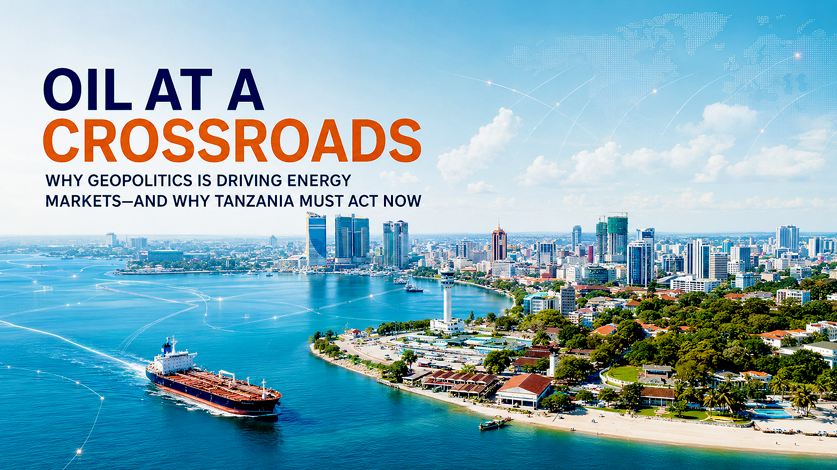
Renewed insecurity along the world’s most important petroleum routes is restoring the geopolitical premium in oil prices. For Tanzania, the immediate danger is imported inflation; the larger opportunity is to become East Africa’s energy and petroleum logistics hub.
For a few fleeting days, diplomacy appeared to be removing some of the fear from global oil markets. A memorandum of understanding between the United States and Iran had raised hopes that the risk of a wider confrontation—and the disruption of Middle Eastern energy supplies, might begin to recede.
The relief did not last.
Renewed security concerns around the Strait of Hormuz and the Bab el-Mandeb Strait quickly returned traders’ attention to the vulnerability of the maritime routes connecting Middle Eastern producers with consumers in Asia, Europe and beyond. The Strait of Hormuz alone carries roughly one-fifth of global petroleum consumption, while Bab el-Mandeb is a critical gateway between the Red Sea, the Suez Canal and the Indian Ocean.
When either corridor becomes less secure, the market does not wait for tankers to stop moving. It begins pricing the possibility that they might.
That risk premium was visible in the sharp movement of international oil benchmarks. Brent crude traded at approximately US$85.05 a barrel on 28 July, while West Texas Intermediate stood near US$79.26, leaving a spread of about US$5.80 between the two contracts. Within less than 24 hours, Brent had rebounded to approximately US$87.80 as anxiety over maritime security intensified.
The movement was more than another volatile trading session. It illustrated how quickly geopolitical risk can overwhelm conventional calculations about inventories, demand and production.
The return of the geopolitical barrel
Oil is priced not only according to how much is available today, but also according to how much traders believe will remain available tomorrow. A threatened shipping lane can therefore exert almost as much influence as an interrupted oilfield.
This is particularly important in a market where vessels may be forced to take longer routes, shipping insurance becomes more expensive and freight rates rise. Even when the physical supply of crude remains unchanged, the effective cost of delivering it increases. Refiners and fuel importers must then pay for a more complicated and hazardous supply chain.
Investor positioning reinforces this interpretation. Hedge funds and institutional investors increased their net-long exposure in ICE Brent futures and options to the equivalent of more than 192 million barrels, the strongest bullish position in almost two months. In effect, a growing number of investors were betting that prices would rise further.
Yet this bullish turn is unfolding in a thinner market. Open interest in ICE Brent remained about 11% below its level a year earlier. Lower participation can reduce liquidity, making prices more sensitive to sudden changes in sentiment and amplifying daily movements.
The refined-products market is transmitting a similarly important signal. Hedge funds increased bullish positions in ICE Gasoil, the European diesel benchmark, to 84,540 contracts. That reflects mounting concern about the availability and cost of middle distillates, which power freight transport, heavy industry, mining, agriculture and large parts of the global logistics economy.
A crude-price shock attracts headlines. A prolonged diesel squeeze can spread more deeply through the productive economy.
Big capital still believes in hydrocarbons
The resurgence of geopolitical risk comes as major investors continue committing billions of dollars to oil and gas infrastructure. That may appear inconsistent with the accelerating transition towards cleaner energy, but the two trends are not mutually exclusive.
Expand Energy, the largest independent natural-gas producer in the United States, announced a US$1.25 billion acquisition of Twin Eagle Holdings to strengthen its logistics and gas-marketing capabilities. Apollo Global Management committed US$1.5 billion to offshore drilling assets in Asia. Nigeria’s Dangote Refinery, meanwhile, secured US$2.5 billion in private financing as it pursues a proposed expansion from 650,000 barrels a day to as much as 1.4 million by the end of 2028.
These investments do not mean the energy transition has stalled. They demonstrate that global capital expects oil and gas to remain commercially and strategically important during a long, uneven transition.
Electric vehicles, renewable power and cleaner fuels will continue to expand. But aviation, shipping, petrochemicals, heavy transport and industrial production will remain substantially dependent on hydrocarbons for years. Investors are positioning themselves around that reality, particularly where refining capacity, storage, trading and logistics can generate returns regardless of which producer supplies the original barrel.
For Africa, the planned expansion of the Dangote complex could be especially consequential. A refinery of that scale would not merely increase Nigeria’s production of petroleum products; it could redraw fuel-trading patterns across the continent and intensify competition among ports, storage operators and regional distributors.
Tanzania’s immediate exposure
Tanzania is not insulated from these developments. As a net importer of refined petroleum products, the country is exposed to both the international price of fuel and the cost of transporting it.
A sustained rise in oil prices would increase the petroleum import bill and create additional demand for foreign currency. It could also raise domestic pump prices and transport costs, with effects spreading through food distribution, construction, manufacturing, mining, tourism and agriculture.
The inflationary transmission can be deceptively broad. Farmers pay more to operate machinery and transport produce. Manufacturers face higher freight and backup-power costs. Mining companies spend more moving materials and running heavy equipment. Public transport operators confront pressure on margins, while households ultimately absorb higher prices for goods transported over long distances.
The effect on Tanzania will depend partly on the shilling, procurement arrangements, freight costs and the timing of domestic price adjustments. But the strategic warning is already clear: energy security cannot be managed solely as a question of purchasing sufficient fuel for the next delivery cycle.
It requires infrastructure capable of absorbing shocks.
From fuel importer to regional energy gateway
Tanzania’s vulnerability is matched by an unusual geographic opportunity. Its Indian Ocean coastline and transport connections place it within reach of several landlocked markets, including Rwanda, Burundi, Uganda, Zambia and the Democratic Republic of Congo.
That geography is valuable, but geography alone does not create a logistics hub. Reliability does.
To strengthen its position, Tanzania should accelerate investment in petroleum-handling capacity at Tanga and other strategically located ports, expand both commercial and strategic storage, and improve the road and rail systems connecting import terminals with inland markets. The Central Corridor will be especially important as competition increases among regional gateways seeking to serve Central and East Africa.
Storage deserves particular attention. Greater reserves would provide a buffer against delayed shipments, temporary closures of maritime routes and sudden increases in international prices. Properly designed facilities could also support regional distribution, allowing Tanzania to function not simply as a transit route but as a centre for aggregation, blending, trading and supply management.
Infrastructure must be accompanied by competitive customs procedures, predictable regulation and efficient border operations. A fuel cargo discharged quickly at port but delayed along an inland corridor loses much of its commercial advantage. Regional customers will gravitate towards the route offering the best combination of price, speed and reliability.
Tanzania should therefore think of ports, terminals, roads, railways, pipelines, border posts and digital clearance systems as one integrated energy-logistics platform.
Oil marketers must become energy companies
Tanzania’s oil-marketing companies also face a strategic choice. Businesses built primarily around importing and distributing conventional fuels must prepare for a market shaped simultaneously by geopolitical disruption, regional competition and technological transition.
The first priority is resilience. OMCs should diversify their sources of supply, develop longer-term procurement relationships and reduce dependence on any single trading route or supplier. Real-time market intelligence, digital inventory controls and more sophisticated price-risk management would enable companies to respond faster when international conditions change.
The second priority is regional scale. Tanzanian operators should consider expanding cross-border distribution networks, securing supply agreements with large industrial customers and investing in strategically located storage terminals. Companies that can guarantee dependable delivery across several markets will be better positioned than those competing only for domestic retail volumes.
The third is diversification. Liquefied natural gas and compressed natural gas could play a larger role in transport and industry, particularly where Tanzania can draw upon its substantial domestic gas resources. Sustainable aviation fuel and biofuels may open new opportunities as airlines and global supply chains face tighter emissions requirements. Electric-vehicle charging will also become increasingly relevant, especially in urban transport fleets and along major commercial routes.
The objective should not be an abrupt abandonment of petroleum. It should be the deliberate transformation of oil-marketing companies into broader energy and mobility businesses.
A strategic agenda for Tanzania
The current disruption points towards five national priorities:
Expand strategic petroleum reserves to provide greater protection against shipping interruptions and sudden price shocks.
Upgrade port and terminal infrastructure, particularly where it can support both domestic security and regional exports.
Modernise the Central Corridor through coordinated investment in roads, railways, border systems and digital cargo management.
Strengthen fuel-market intelligence so policymakers and importers can anticipate changes in prices, freight costs, inventories and regional demand.
Accelerate energy diversification through natural gas, biofuels, renewable power, cleaner transport and electric-mobility infrastructure.
These priorities require coordination among the Government, port and transport authorities, regulators, financial institutions, energy companies and regional partners. They also require financing structures capable of attracting private capital into commercially viable infrastructure.
The forthcoming infrastructure-investment discussions in Dar es Salaam offer Tanzania an opportunity to present energy logistics not as a collection of isolated projects, but as part of a larger regional economic proposition.
The opportunity inside the shock
The central lesson from the week ending 28 July is not simply that oil prices can rise quickly. It is that energy markets are once again being governed by the security of narrow waterways, the decisions of political leaders and the willingness of investors to pay for protection against uncertainty.
Tanzania cannot control the Strait of Hormuz. It cannot guarantee security in Bab el-Mandeb. Nor can it determine the direction of global oil prices.
What it can control is its preparedness.
With stronger reserves, efficient ports, modern transport corridors, diversified suppliers and forward-looking energy companies, Tanzania can reduce the cost of external shocks while expanding its influence across the region. Without such investment, each geopolitical crisis will continue to arrive domestically through higher import costs, transport fares and consumer prices.
The oil market may be at a crossroads, but Tanzania’s strategic direction should be clear: convert geographic advantage into infrastructure, infrastructure into reliability, and reliability into regional energy leadership.