Tanzania Parliament Approves Record $24 Billion Budget as Government Bets on Growth, Infrastructure and Fiscal Self-Reliance
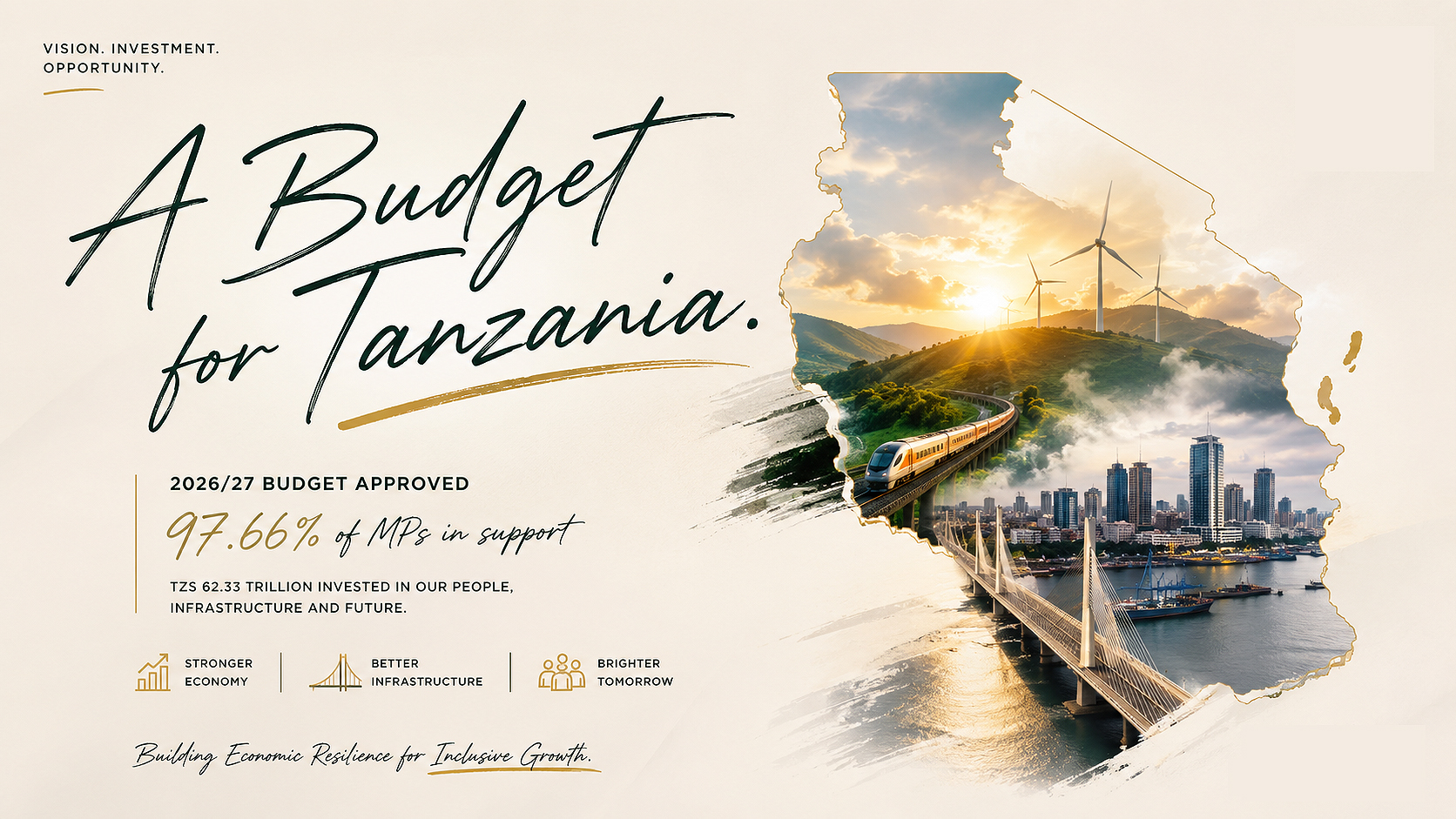
Tanzania’s Parliament has approved the government’s 2026/27 budget, handing President Samia Suluhu Hassan’s administration a strong political mandate to pursue one of the most ambitious spending plans in the country’s history. Lawmakers voted 385 to 8 in favor of the budget, representing a 97.66% approval rate, authorizing the government to begin deploying a record TZS 62.33 trillion ($24 billion) fiscal package aimed at accelerating economic growth, expanding infrastructure and strengthening domestic revenue generation.
The approval marks a significant milestone for East Africa’s third-largest economy as it seeks to sustain momentum from recent years of robust growth. Finance Minister Ambassador Khamis Mussa Omar presented the budget as part of a broader strategy to build economic resilience through digital transformation, strategic investment and fiscal sustainability, themes that underpin the government’s development agenda.
The spending plan represents a 10.3% increase from the previous fiscal year and reflects Tanzania’s confidence in its economic trajectory. According to government projections, domestic revenue will account for approximately 74.2% of total budget financing, highlighting an increasingly deliberate shift away from aid dependence toward internally generated resources.
Revenue Engine Expands
The government expects to raise TZS 46.79 trillion in revenue during the fiscal year, including TZS 36.99 trillion from taxes and TZS 9.24 trillion from non-tax sources and local government collections. Grants from development partners are projected at just TZS 563 billion, a relatively modest share of total financing.
The emphasis on domestic resource mobilization comes as Tanzania continues to report strong tax collection performance. Government data show revenue collection exceeded targets during much of the previous fiscal year, supported by digital tax administration reforms, expansion of the tax base and improved voluntary compliance. Economic growth of 5.9% in 2025, inflation averaging 3.4%, and private-sector credit growth exceeding 20% have provided a favorable backdrop for revenue generation.
For investors, the message is clear: Tanzania is increasingly seeking to finance its development ambitions from its own economy rather than relying heavily on external assistance.
Infrastructure Remains the Centerpiece
The budget reinforces Tanzania’s long-standing infrastructure-led development model. Significant resources will continue flowing into transport, energy, water, education and healthcare projects that have become hallmarks of the government’s investment strategy.
Recent public investments have supported major initiatives including the Standard Gauge Railway (SGR), expansion of electricity generation capacity, rural electrification, road construction, water projects and social-sector infrastructure.
Government officials argue these investments are strengthening productivity, lowering business costs and enhancing the country’s attractiveness as a regional logistics and manufacturing hub.
Parliament Speaker Mussa Azzan Zungu emphasized that legislators will closely monitor implementation, urging government agencies to ensure public welfare remains the primary objective of spending decisions.
“The people’s interests must come first,” Zungu said after announcing the vote, adding that Parliament would continue oversight to ensure projects deliver tangible benefits to citizens.
Fiscal Balancing Act
Despite strong revenue expectations, the government projects a budget deficit of TZS 7.71 trillion, underscoring the challenge of financing rapid development while maintaining fiscal discipline.
To bridge the gap, Tanzania plans to borrow TZS 15.54 trillion during the fiscal year. Domestic borrowing is expected to account for TZS 6.56 trillion, while concessional external financing will contribute TZS 6.55 trillion. A further TZS 2.43 trillion will come from commercial external borrowing.
At the same time, the government expects to repay TZS 7.84 trillion in maturing debt obligations.
The borrowing strategy follows the government’s medium-term debt management framework and comes as authorities continue to emphasize debt sustainability. Official assessments indicate Tanzania’s debt remains within prudent thresholds, supported by steady economic growth and continued expansion of fiscal capacity.
A Test of Execution
While the parliamentary vote removes political uncertainty surrounding the budget, attention now shifts to implementation.
The scale of the spending package reflects Tanzania’s ambition to transform itself into a more industrialized, connected and self-sustaining economy. Yet success will ultimately depend on whether projected revenues materialize, infrastructure projects are delivered efficiently and borrowing remains aligned with long-term fiscal sustainability.
The next major legislative milestone arrives on June 24, when Parliament is expected to debate and approve the Finance Bill 2026, which will provide the tax and regulatory framework required to support the newly approved budget.
For markets, businesses and development partners, the vote signals continuity rather than change: Tanzania remains firmly committed to a growth model built on strategic public investment, expanding domestic revenues and gradual economic transformation, an approach that policymakers believe will position the country for sustained growth in the decade ahead.
Key Takeaway
Tanzania’s 2026/27 budget is not simply a spending plan, it is a strategic investment blueprint designed to accelerate economic transformation through infrastructure, domestic revenue growth, digital modernization, and greater fiscal self-reliance.
Executive Takeaways
Record Budget: Parliament approved a historic TZS 62.33 trillion ($24 billion) budget, the largest in Tanzania’s history.
Strong Political Mandate: The budget passed with 97.66% parliamentary support, providing policy certainty for investors and businesses.
Self-Reliance Strategy: 74.2% of total financing will come from domestic resources, reducing dependence on foreign aid.
Infrastructure First: Major investments continue in railways, roads, energy, water, education, healthcare, and logistics infrastructure.
Economic Resilience: The budget aligns with a broader strategy of digital transformation, strategic investment, and fiscal sustainability.
Revenue Confidence: Government expects to collect TZS 46.79 trillion in revenue, supported by tax administration reforms and economic growth.
Private Sector Opportunity: Continued public investment is expected to create opportunities across construction, manufacturing, transport, finance, energy, and technology.
Managed Borrowing: While the budget includes a deficit, authorities maintain that debt remains within sustainable levels and is being directed toward productive investments.
Execution Is Everything: The success of the budget will ultimately depend on implementation, project delivery, and revenue performance.
Bottom Line
The 2026/27 budget signals that Tanzania is doubling down on a long-term development model centered on infrastructure, productivity, and economic self-reliance, positioning itself as one of Africa’s most ambitious growth stories.