Tanzania–Rwanda Trade Ties Deepen as Kagame, Samia Advance Rail, Port and Energy Projects
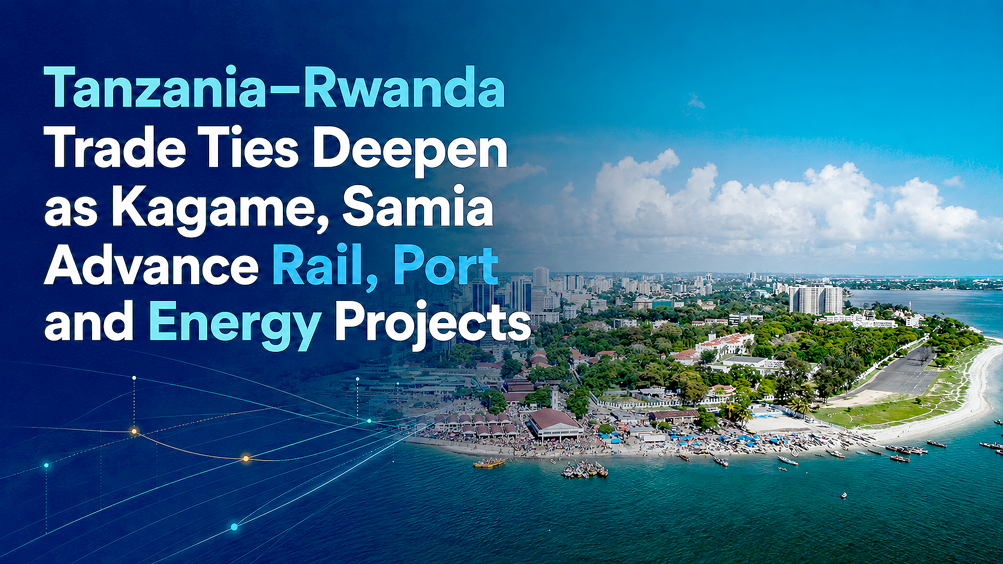
DAR ES SALAAM — Tanzania and Rwanda are seeking to convert one of East Africa’s closest political relationships into a more efficient commercial partnership, placing ports, railways, electricity and the removal of trade barriers at the centre of their bilateral agenda.
Tanzanian President Samia Suluhu Hassan and Rwandan President Paul Kagame held talks at State House in Dar es Salaam during Kagame’s one-day working visit on May 3. The discussions focused on expanding trade and investment, improving transport links, developing shared infrastructure and strengthening energy cooperation.
The economic logic is compelling. Bilateral trade reached TSh644 billion in 2025, while the Tanzania Investment Centre registered 42 Rwandan projects valued at $325.5 million between 1990 and March 2026. Those investments created 2,225 Tanzanian jobs, according to the Tanzanian presidency.
Yet those figures capture only part of the relationship. For landlocked Rwanda, Tanzania is a critical gateway to international markets. About 70% of Rwanda’s cargo passes through Tanzanian ports, making the efficiency of the Central Corridor a strategic concern for Kigali and a significant commercial opportunity for Dar es Salaam. Tanzania’s State House
That dependence gives Tanzania an increasingly important role in East Africa’s logistics economy. The Port of Dar es Salaam and the wider network of roads, railways, dry ports and storage facilities serving the corridor connect Rwanda—and other landlocked regional economies, , Samia Suluhu Hassan, Central Corridor, East African Communityto the Indian Ocean.
For Tanzania, the opportunity extends beyond collecting port fees. Greater Rwandan cargo volumes can support investment in warehousing, freight forwarding, insurance, financial services and industrial logistics. But capturing that value will depend on whether the two governments can reduce delays, eliminate non-tariff barriers and improve coordination between customs and transport agencies.
The Railway Question
The proposed Isaka–Kigali railway remains the most consequential infrastructure project on the bilateral agenda.
The line would connect Rwanda to Tanzania’s standard-gauge railway network through Isaka in northwestern Tanzania, creating a rail-based route from Kigali toward the Port of Dar es Salaam. If implemented, it could reduce freight costs, shorten delivery times and give exporters a more predictable alternative to long-distance road transport.
For Rwanda, the railway represents economic security. For Tanzania, it could consolidate the Central Corridor’s position in an increasingly competitive regional logistics market.
East Africa’s ports and transport corridors are competing for the same hinterland cargo. Rwanda can access global markets through Tanzania’s Central Corridor or Kenya’s Northern Corridor, giving Kigali an incentive to favour the route offering the best combination of price, reliability and speed.
That means diplomacy alone will not guarantee traffic for Tanzania. Port efficiency, railway execution, border processing and the quality of supporting logistics services will ultimately determine whether cargo owners choose Dar es Salaam.
President Kagame said the two countries must ensure their systems are equipped to manage growing business volumes and called for the full implementation of joint projects. He described Tanzania as a key partner in connecting Rwanda to global markets. Office of President Paul Kagame
Power Across Borders
Energy offers another route through which political cooperation can translate into economic gains.
The two leaders reviewed the 80-megawatt Rusumo Falls Hydroelectric Project, jointly developed by Tanzania, Rwanda and Burundi. The cross-border plant demonstrates how shared infrastructure can distribute costs, improve energy security and create economic benefits across national boundaries.
They also discussed electricity-trading arrangements between Tanzania Electric Supply Company and Rwanda Energy Group. Expanded power trade could help both countries manage supply fluctuations while supporting industrial production, mining, services and other electricity-intensive activities.
For investors, the importance of cross-border electricity goes beyond the volume of power traded. Reliable energy is one of the principal conditions for industrial competitiveness. A regional market that can move electricity to where it is most needed could reduce shortages, strengthen grid resilience and support larger investments.
From Diplomacy to Delivery
The meeting also covered defence, security, immigration and coordination within the East African Community, African Union and other international institutions. But the clearest measure of success will be commercial implementation.
Tanzania and Rwanda agreed to accelerate efforts to address non-tariff barriers and make better use of the EAC Common Market and the African Continental Free Trade Area. Those commitments are significant because regional trade is often constrained less by formal tariffs than by administrative delays, inconsistent regulations, border procedures and transport costs.
Removing such barriers would benefit companies on both sides of the border, particularly manufacturers, agricultural exporters and logistics providers. It would also strengthen Tanzania’s claim to be more than a transit country: a regional production, distribution and investment platform.
The Kagame visit therefore reflected a broader change in East African diplomacy. High-level engagements are increasingly being judged by their ability to move cargo, deliver electricity, mobilise investment and lower the cost of doing business.
Tanzania enters that competition with a geographic advantage: an Indian Ocean coastline, a major port system and direct transport connections to several landlocked economies. Geography, however, creates potential, not guaranteed returns.
The next phase of Tanzania–Rwanda relations will depend on execution: removing persistent trade barriers, improving cargo handling, completing strategic railway links and building dependable energy markets.
If Dar es Salaam and Kigali deliver on those priorities, the partnership could become a practical demonstration of regional integration, measured not by communiqués, but by faster freight, stronger investment and a larger flow of commerce across East Africa.