Tanzania Turns Bullion into Strategic Economic Strength.
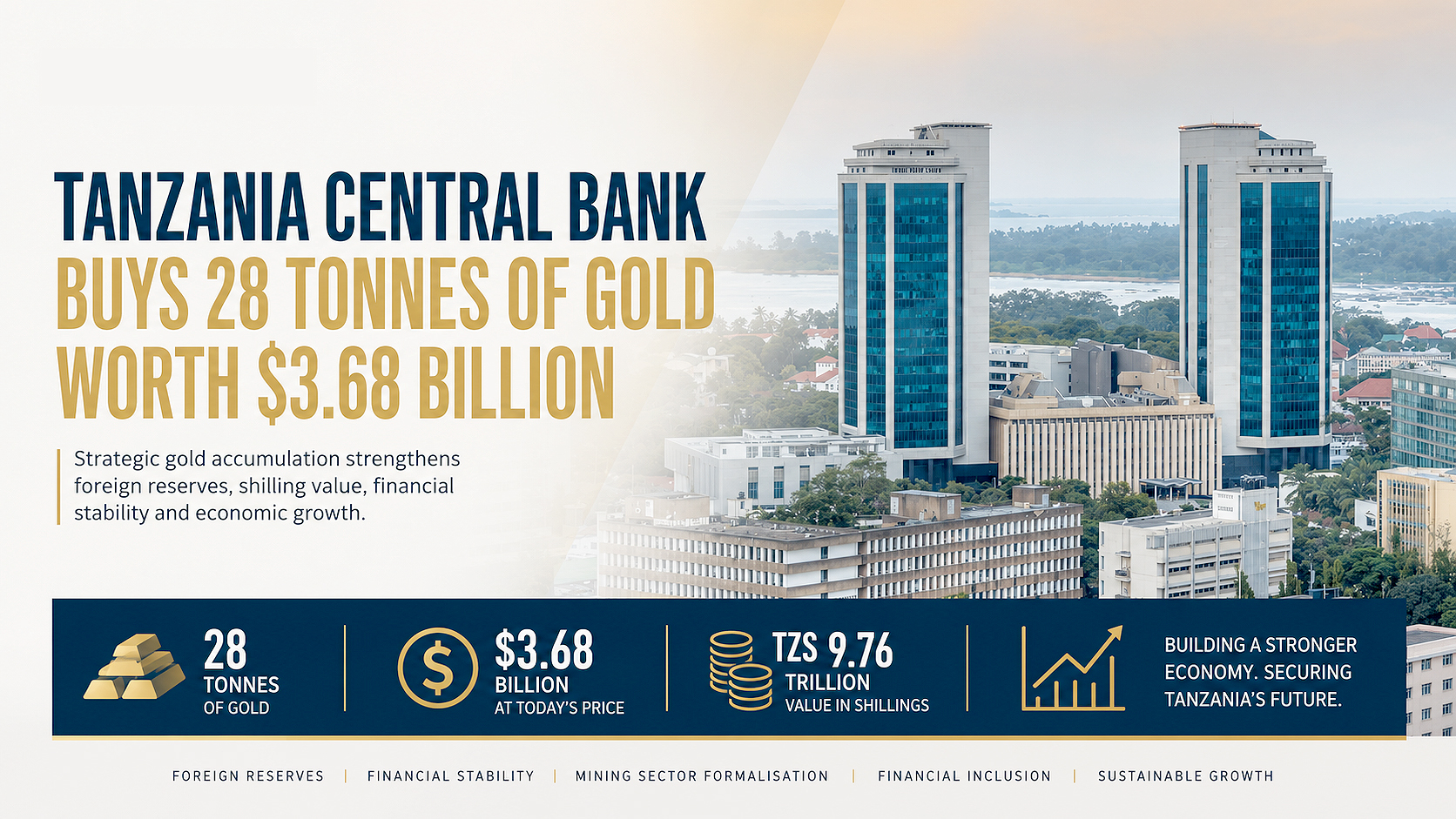
Over the past 18 months, Tanzania's central bank has accumulated 28 tonnes of gold worth US$3.68 billion, using strategic reserve management to strengthen foreign exchange reserves, support the shilling, deepen financial inclusion and enhance long-term economic resilience.
-----------------------
Tanzania has accumulated approximately 28 tonnes of gold worth US$3.68 billion (TZS 9.76 trillion) over the past 18 months as part of a strategic reserve management programme designed to strengthen foreign exchange reserves, support the Tanzanian shilling, reinforce financial sector resilience and underpin long-term economic growth.
Bank of Tanzania (BoT) Governor Emmanuel Tutuba disclosed the figures while participating in a high-level discussion on Central Bank Gold Operations during the 2026 African Caucus Meeting of the World Bank Group and the International Monetary Fund (IMF) in Banjul, Gambia.
The African Caucus brings together finance ministers, central bank governors and policymakers from 54 African countries, alongside representatives from the World Bank, IMF and international development institutions.
Governor Tutuba said Tanzania's gold purchasing strategy extends well beyond reserve diversification.
According to him, the programme has simultaneously formalised parts of the country's mining industry while expanding financial inclusion among mineral traders, particularly artisanal and small-scale miners.
As part of the initiative, the central bank has facilitated the opening of more than 4,000 bank accounts for gold traders and miners across financial institutions, bringing previously underserved participants into the formal financial system.
The programme has also received strong market support because the Bank of Tanzania purchases gold at internationally competitive prices while guaranteeing rapid settlement.
"We pay gold miners and traders within 24 hours of the transaction and at the prevailing London gold market price on the day of sale," Governor Tutuba said. "This has significantly encouraged miners and traders to sell their gold to the central bank."
The strategy reflects a growing global trend among central banks to increase gold holdings as a hedge against external economic shocks, currency volatility and geopolitical uncertainty.
For Tanzania, the policy serves multiple macroeconomic objectives: strengthening reserve assets, reducing reliance on foreign currencies, supporting monetary stability and enhancing confidence in the domestic financial system.
The Tanzanian delegation to the African Caucus is led by Minister of Finance Ambassador Khamis Mussa Omar, accompanied by Zanzibar's Minister of Finance and Planning Dr Juma Malik Akil, Bank of Tanzania Governor Emmanuel Tutuba and Tanzania's Ambassador to Nigeria, Selestine Kakele, who also oversees diplomatic affairs in The Gambia.
Held at the Sir Dawda Kairaba Jawara International Conference Centre (SDJK) in Banjul, the African Caucus serves as Africa's principal platform for coordinating positions within the IMF and the World Bank. Discussions this year focus on debt sustainability, climate finance, infrastructure investment, poverty reduction, employment creation, trade expansion and structural economic reforms across the continent.
Tanzania's gold reserve accumulation programme is increasingly being viewed as an example of how monetary policy can simultaneously strengthen macroeconomic stability, formalise strategic sectors of the economy and deepen financial inclusion while enhancing the country's resilience against external shocks.