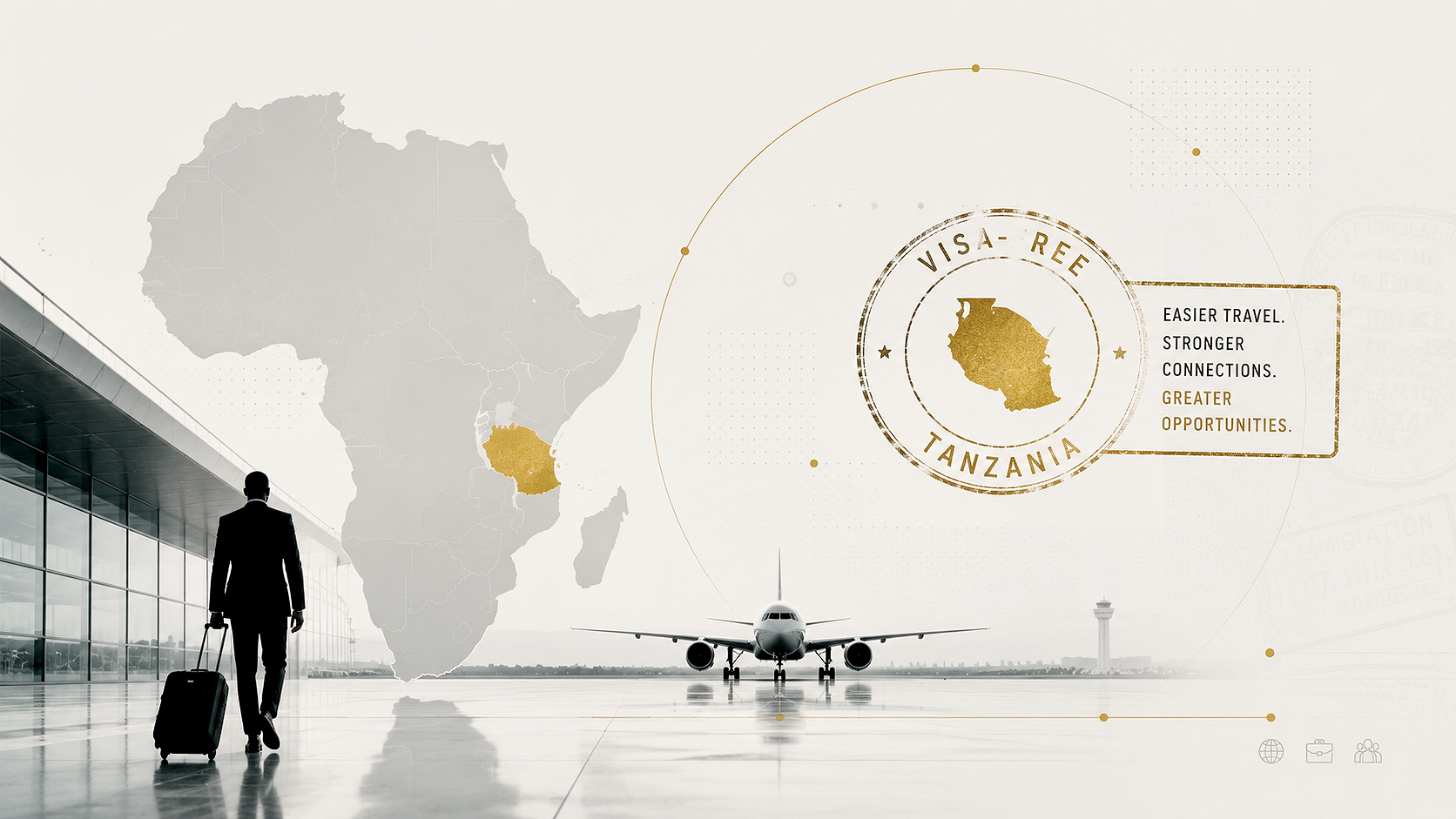
Tanzania Unveils Updated List of Visa-Free Countries to Ease International Travel
The Economics of Openness
Every nation has two gateways to the world.
The first is physical infrastructure, its ports, airports, highways and railways. The second is policy. Even the most sophisticated transport network loses some of its economic value if moving people across borders remains unnecessarily complex. That is why immigration policy has steadily evolved from being viewed purely as a matter of national security into an increasingly important instrument of economic strategy.
Tanzania's updated publication of countries whose nationals are exempt from visa requirements reflects this evolution. While the immediate purpose is to provide clarity for travellers, the wider implications extend into tourism, trade, investment and diplomacy. Governments increasingly understand that international mobility facilitates the movement of ideas, capital and expertise long before it generates measurable economic statistics.
For businesses, every unnecessary administrative requirement represents additional cost. For tourists, uncertainty surrounding entry requirements can influence destination choices. For investors, the ease of arranging an exploratory visit often becomes one of the earliest indicators of how efficiently a country conducts business.
Border policy, in other words, has become part of economic policy.
Travel Begins with Confidence
Modern travel does not begin at an airport.
It begins with research.
Before purchasing airline tickets or reserving accommodation, travellers seek answers to practical questions. They want to know whether they require a visa, how long they may stay, what documents are necessary and whether the process is straightforward. Business executives planning investment missions ask the same questions, as do conference organisers, researchers and development partners coordinating international meetings.
When governments communicate immigration requirements clearly, they remove one of the most significant sources of uncertainty associated with international travel. Publishing an official and accessible list of visa-free countries therefore serves an important purpose beyond administrative compliance. It provides certainty at the earliest stage of decision-making, allowing visitors to plan with greater confidence.
That confidence often determines whether a journey begins at all.
Strengthening Tanzania's Tourism Advantage
Tanzania possesses one of the world's most diverse tourism portfolios. From the Serengeti ecosystem and the Ngorongoro Conservation Area to Mount Kilimanjaro, Zanzibar and a coastline stretching more than 1,400 kilometres, the country has long enjoyed natural advantages that few destinations can match.
Natural attractions alone, however, no longer guarantee competitiveness.
Travellers today evaluate destinations through a wider lens. Flight connectivity, digital services, safety, accommodation quality and immigration procedures increasingly influence purchasing decisions alongside iconic landscapes and cultural experiences. The overall visitor experience now begins well before arrival, shaped by how simple or complicated a destination appears during the planning process.
By clearly identifying countries eligible for visa-free entry, Tanzania strengthens the accessibility of its tourism offering. The policy does not create new attractions, but it removes unnecessary uncertainty for many visitors considering the country for business or leisure. In a highly competitive global tourism market, such incremental improvements often influence thousands of travel decisions over time.
Mobility as an Investment Strategy
Foreign investment seldom begins with signatures on contracts.
It usually begins with conversations.
Investors visit industrial parks before financing factories. Manufacturers inspect logistics corridors before establishing regional operations. Financial institutions meet regulators before expanding into new markets. Technology companies explore partnerships before opening offices. Every major investment is preceded by multiple visits that allow decision-makers to understand local conditions and assess commercial opportunities first-hand.
Visa facilitation cannot substitute for sound macroeconomic management, predictable regulation or quality infrastructure. Those remain the principal drivers of long-term investment. Yet simplifying legitimate travel reduces one of the earliest points of friction in the investment process, enabling businesses to evaluate opportunities more efficiently.
This is particularly significant as Tanzania continues to position itself as a regional investment destination through major infrastructure projects, expanding energy capacity, industrial development zones and improved transport networks. Making the country easier to access complements these broader reforms by ensuring that mobility supports, rather than constrains, economic ambition.
Regional Integration Beyond Agreements
Africa's economic future will depend not only on the movement of goods but also on the movement of people.
The African Continental Free Trade Area, alongside regional organisations such as the East African Community and the Southern African Development Community, seeks to deepen economic integration across the continent. Achieving those ambitions requires entrepreneurs to attend trade exhibitions, researchers to collaborate across institutions, professionals to participate in regional conferences and businesses to explore opportunities beyond national borders.
Trade agreements establish the legal framework for integration, but people transform those agreements into commercial relationships.
Tanzania's visa-free arrangements contribute to this broader objective by facilitating legitimate travel while reinforcing the country's role as a strategic gateway connecting Eastern, Central and Southern Africa. As transport infrastructure improves and regional markets become increasingly interconnected, efficient mobility policies become an essential complement to physical infrastructure.
Balancing Accessibility with Security
Greater openness does not imply weaker border controls. In fact, the opposite is increasingly true. Modern immigration systems rely on advanced technologies, biometric verification, intelligence sharing and risk-based screening to distinguish between legitimate travellers and potential security threats. Rather than applying identical procedures to every visitor, governments increasingly tailor immigration processes according to assessed levels of risk.
Tanzania's immigration framework reflects this balanced approach through differentiated entry requirements, including visa-free access for eligible countries, standard visa procedures and referral visa categories where additional review is necessary. Such systems enable the country to facilitate legitimate travel while maintaining the integrity of its borders and protecting national interests.
The objective is not unrestricted movement.
It is intelligent mobility.
A Small Policy with Broad Implications
Publishing an updated list of visa-free countries may appear to be a routine administrative exercise. Yet its significance reaches far beyond immigration offices. The policy influences tourism planning, business travel, academic collaboration, diplomatic engagement and investor confidence. It provides airlines with certainty, travel agencies with authoritative information and international visitors with greater confidence when choosing Tanzania as a destination.
In today's global economy, competitive advantage is often built through the accumulation of seemingly modest improvements rather than dramatic policy shifts. Simplifying legitimate travel is one such improvement. On its own, it does not transform an economy. Combined with sound institutions, modern infrastructure and a stable investment climate, however, it becomes part of a much larger story about national competitiveness.
Conclusion
As countries compete more intensely for tourists, investment and international partnerships, immigration policy is becoming an increasingly important element of economic strategy. Tanzania's publication of its updated visa-free country list demonstrates an understanding that openness, transparency and efficient border management can reinforce one another rather than exist in tension.
Sometimes the policies with the greatest economic impact are not the most expensive.
They are simply the ones that make it easier for the world to arrive.
Key Takeaways
Tanzania has published its updated list of visa-free countries, providing greater certainty for eligible international travellers.
Transparent immigration policies support tourism, foreign investment, business travel and economic diplomacy.
Easier mobility complements Tanzania's wider investments in infrastructure and regional economic integration.
Modern border management combines openness with sophisticated security systems and risk-based immigration controls.
Visa policy has become an increasingly important component of national competitiveness in the global economy.