Tanzania’s First Offshore Shilling Bond, Explained: Who Borrowed, Where the Money Goes and Why It Matters
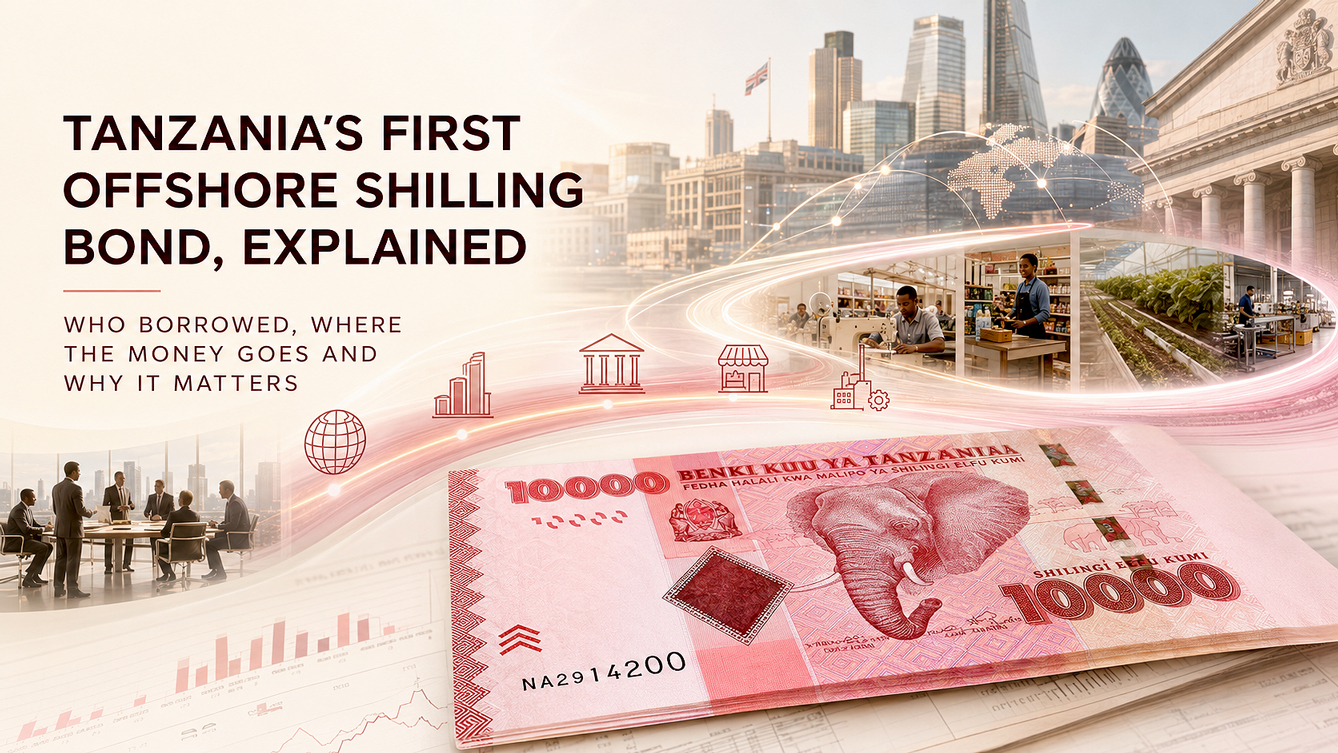
The US$100 million transaction links global investors, IFC and NMB Bank in three distinct steps, opening a new international financing channel for Tanzania’s enterprise economy without adding to sovereign debt.
Tanzania has marked an important capital-market first: the listing of an offshore bond denominated in Tanzanian shillings on the London Stock Exchange.
The achievement is easy to misunderstand. It may sound as though the Government of Tanzania travelled to London to borrow US$100 million. It did not. Nor did NMB Bank issue a bond directly to international investors.
Instead, the transaction connects three separate operations. Global investors bought a shilling-denominated bond issued by the International Finance Corporation. IFC linked that funding to a five-year facility for NMB Bank. NMB is expected to channel the money into loans for Tanzanian micro, small and medium-sized enterprises.
That distinction matters. Properly understood, the deal is not another entry on Tanzania’s sovereign borrowing ledger. It is an attempt to bring longer-term international capital into the country’s productive economy while reducing the currency risks faced by businesses earning their revenues in shillings.
Step one: IFC issued the bond
The International Finance Corporation, the World Bank Group institution focused on private-sector development, issued a TSh265.2 billion bond worth approximately US$100 million.
The instrument carries a 7.60% coupon and matures in June 2031. Goldman Sachs International placed the issue, which was subsequently listed in London.
Investors buying the bond are therefore lending to IFC, not to the Tanzanian Government and not directly to NMB Bank. They receive exposure to a shilling-denominated instrument while relying on IFC’s credit standing.
This structure gives Tanzania’s currency a new international platform. Offshore investors have traditionally found direct exposure to African local-currency markets difficult because of regulatory, liquidity and settlement constraints. An IFC-issued instrument provides a more familiar route through which investors can participate.
For Tanzania, the significance is partly reputational. A shilling instrument has been structured, placed and listed in one of the world’s leading financial centres. That does not instantly create a deep offshore market, but it establishes a precedent from which future transactions can develop.
Step two: IFC linked the funding to NMB
The second part of the transaction takes place away from the trading screen.
IFC’s investment disclosure describes an up-to-US$100 million-equivalent senior loan denominated in, or linked to, the Tanzanian shilling for NMB Bank. The facility runs for up to five years and includes a two-year grace period.
This currency matching is one of the transaction’s most important economic features.
Most Tanzanian businesses earn their income in shillings. When such companies borrow in dollars, they acquire a liability that may become more expensive even when the underlying business is performing well. If the shilling depreciates, more local currency is required to meet the same dollar interest or principal payment.
A farmer, manufacturer, logistics company or hotel can consequently face financial stress caused not by weak sales or poor management, but by movements in the foreign-exchange market.
Shilling-linked finance reduces that mismatch. Borrowers can service their obligations in the currency in which they generate revenue, improving cash-flow predictability and allowing investment decisions to be based more closely on business fundamentals.
This is particularly valuable for smaller companies, which rarely have the scale, expertise or financial instruments needed to hedge foreign-exchange exposure.
Step three: NMB lends to Tanzanian enterprises
NMB is expected to use the facility to expand lending to micro, small and medium-sized enterprises, the businesses that populate Tanzania’s farms, markets, workshops, transport networks, factories and service industries.
These enterprises provide livelihoods and sustain domestic supply chains, yet many struggle to obtain financing with maturities long enough to support meaningful expansion. Short-term credit may help purchase inventory, but investment in machinery, processing facilities, technology and new premises normally requires more patient funding.
The IFC facility is intended to relieve part of that constraint.
Twenty per cent of the financing is targeted at women-owned MSMEs. If the full US$100 million equivalent is deployed, the target would represent approximately US$20 million in financing for women-owned enterprises, although the final shilling value and actual allocation will depend on exchange rates and loan deployment.
That emphasis is commercially as well as socially relevant. Women-owned businesses are deeply embedded in Tanzania’s agriculture, trade, tourism, manufacturing and service sectors, but often face more acute collateral and formal-financing constraints. Expanding their access to appropriately structured credit could support formalisation, employment and household income across several layers of the economy.
Why is there a first-loss guarantee?
Up to US$40 million of the project is supported by first-loss credit enhancement under the World Bank Group’s IDA20 Private Sector Window MSME Finance Platform. The remaining US$60 million is being processed on a standalone basis.
A first-loss arrangement absorbs an agreed initial portion of eligible losses. By sharing risk, it can make financing viable in market segments that lenders might otherwise approach cautiously.
The guarantee does not excuse NMB or its customers from their repayment obligations. Nor does it transform weak businesses into creditworthy ones. Its purpose is to strengthen the financing structure behind lending to viable enterprises that may lack extensive credit histories, substantial collateral or access to long-term capital.
Used well, the mechanism can help a bank move beyond the safest and most established borrowers without abandoning normal credit discipline.
Did NMB borrow at 7.60%?
Not necessarily.
The 7.60% coupon belongs to the bond issued by IFC to investors. It is the stated annual return on that instrument—not a public disclosure of NMB’s all-in borrowing cost.
NMB’s actual financing cost will depend on its separate agreement with IFC, including the loan’s pricing, currency arrangements, fees, risk-sharing provisions and other contractual terms. Not all those details have been disclosed publicly.
It would therefore be premature to claim that listing the bond in London automatically made NMB’s funding cheaper. The more defensible conclusion is that the structure created access to scarce, longer-term shilling-linked funding and reduced the currency mismatch that can make foreign borrowing dangerous for local businesses.
Affordability will ultimately be judged by the terms offered to Tanzanian enterprises.
This is not sovereign borrowing
The identity of the borrower is particularly important as Tanzania implements its TSh62.33 trillion national budget for 2026/27.
The Government plans TSh15.54 trillion in new borrowing, comprising TSh6.56 trillion from domestic sources, TSh6.55 trillion in external concessional loans and TSh2.43 trillion in external commercial financing.
The IFC–NMB transaction sits outside those plans. It is not a Tanzanian sovereign bond, does not directly finance government expenditure and should not be added to the country’s public borrowing figures.
Instead, it expands Tanzania’s private-sector financing architecture. International investors lend to IFC; IFC provides shilling-linked funding to NMB; and NMB lends to businesses.
This distinction strengthens rather than diminishes the economic story. Tanzania’s long-term development ambitions cannot be financed by the sovereign balance sheet alone. Development Vision 2050 will require banks, companies, institutional investors and international development financiers to mobilise capital alongside the Government.
The bond offers an early example of how that broader financing ecosystem might work.
Why London matters
Listing in London places the instrument before a broad international investment audience and demonstrates that exposure to the Tanzanian shilling can be structured offshore.
It also introduces Tanzania’s capital-market story to investors who may already recognise the country’s improving economic proposition: political stability, a large and youthful population, extensive natural resources, Indian Ocean access and a strategic position serving several landlocked African markets.
Tanzania is investing heavily in railways, ports, energy, aviation and regional trade corridors. These assets can lower the cost of moving goods and increase the country’s value as a production and logistics base. Yet infrastructure generates its full economic return only when businesses can finance the equipment, inventory, technology and working capital needed to use it.
The IFC–NMB facility connects those two sides of development. Public infrastructure expands economic capacity; enterprise finance enables companies to convert that capacity into production, exports and employment.
Still, one bond does not create a functioning offshore shilling market. A mature market would require repeated issuance, a broader investor base, more issuers, greater liquidity and instruments spanning several maturities.
This transaction is better understood as an opening proof of concept.
The real test begins in Tanzania
The London listing is the visible milestone. The economic result will be determined much closer to home.
NMB must now translate institutional funding into accessible loans for productive enterprises. The quality of that process will matter as much as its speed. Longer tenors will be of limited value if loan pricing remains beyond the reach of viable businesses, while headline lending volumes will mean little if the money remains concentrated among a narrow group of established borrowers.
The questions worth tracking are therefore practical:
How quickly will the facility be converted into actual MSME loans?
Will women-owned enterprises receive the targeted 20% allocation?
Which sectors, regions and sizes of business will benefit?
Will financing reach productive investment or remain concentrated in short-term working capital?
What interest rates, maturities and collateral requirements will borrowers face?
How many sustainable jobs will be created or retained?
How will revenue growth, repayment performance and business survival be measured?
Will another offshore shilling transaction follow, and on what terms?
Reports associated with the facility have cited the potential to support between 13,000 and 20,000 jobs. That would be a substantial outcome, but projections should eventually be replaced by measured results distinguishing jobs created from those merely retained or indirectly supported.
From a landmark to a market
The transaction’s greatest value may lie in what follows.
If the bond performs as expected, if NMB deploys the facility successfully and if the underlying businesses repay well, future issuers will have evidence rather than theory. Comparable structures could eventually support agriculture, affordable housing, renewable energy, logistics, industrial development and other sectors requiring long-term local-currency capital.
Tanzanian banks and major companies may also find it easier to diversify their funding if international investors become more comfortable with the shilling and the country’s economic trajectory.
The simplest explanation of the deal is therefore the most accurate: global investors lent to IFC through a shilling-denominated bond; IFC connected that funding to a five-year facility for NMB; and NMB is expected to channel the capital into Tanzania’s enterprise economy.
London supplied the international stage. Tanzania’s economic fundamentals supplied the opportunity.
The transaction will earn its real significance in workshops, farms, shops and growing companies across the country—where capital can become machinery, inventory, jobs and stronger businesses capable of financing the next phase of Tanzania’s development.