Tanzania’s Infrastructure Bet Is Turning Geography into Economic Power
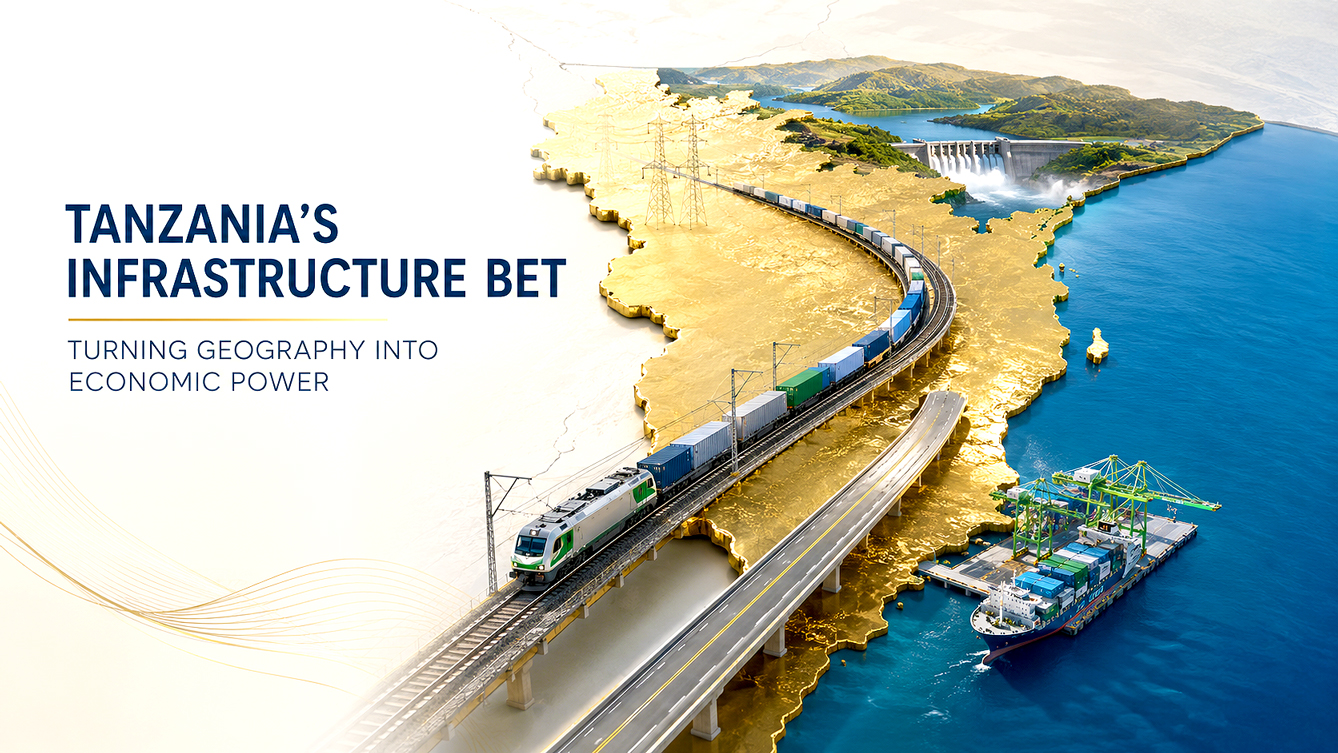
For decades, Tanzania’s location has promised more than its infrastructure could fully deliver. The country occupies nearly 950,000 square kilometres, commands an extensive Indian Ocean coastline and shares borders with eight countries. Six of those neighbours, Uganda, Rwanda, Burundi, the Democratic Republic of the Congo, Zambia and Malawi, depend heavily on regional corridors to reach international markets.
That geography has always made Tanzania strategically important. What is changing is the scale of the infrastructure being constructed around it.
A modern railway is extending inland from the coast. Dar es Salaam’s port is being expanded and modernised. New bridges and upgraded highways are shortening domestic and cross-border journeys. Airports and a dedicated national freighter are opening faster routes for high-value exports. Meanwhile, one of Africa’s largest hydropower projects is adding the electricity required to support manufacturing, mining and logistics.
Taken separately, these are large public works. Considered together, they represent something more ambitious: the construction of an integrated economic corridor connecting the Indian Ocean with some of Africa’s fastest-growing frontier markets.
A continental gateway
Tanzania sits at the intersection of several economic geographies. To the east are the shipping lanes connecting Africa with the Middle East and Asia. To the west lie the mineral-rich territories of the Democratic Republic of the Congo and Zambia. To the north are the increasingly integrated markets of Kenya, Uganda, Rwanda and Burundi. To the south are Malawi and Mozambique.
The country also belongs to the East African Community, the Southern African Development Community and the African Continental Free Trade Area. This gives businesses based in Tanzania a platform from which to serve regional and continental markets potentially encompassing more than 1.5 billion consumers.
But membership in trade agreements does not automatically create trade. Goods still need to move predictably, electricity must remain available, borders must operate efficiently and ports must be able to process rising volumes without costly delays.
Tanzania’s infrastructure programme is an attempt to reduce these physical barriers simultaneously.
The economic backdrop is encouraging. According to the government’s 2026/27 Budget Speech, real GDP expanded by 5.9 per cent in 2025, while nominal output reached TSh234.1 trillion, equivalent to approximately US$91.8 billion. The government is targeting growth of 6.3 per cent in 2026. Inflation averaged 3.4 per cent between July 2025 and April 2026, remaining within the medium-term target of 3–5 per cent.
The World Bank’s February 2026 Tanzania Economic Update similarly describes resilient growth supported by mining, construction, financial services and exports, although it cautions that infrastructure constraints, employment informality and weaknesses in human-capital development continue to limit the inclusiveness of that expansion.
For investors, the central question is therefore no longer whether Tanzania can grow. It is whether new infrastructure can raise productivity sufficiently to turn that growth into a sustained structural transformation.
The railway at the centre of the strategy
The Standard Gauge Railway is the most visible expression of Tanzania’s corridor ambition.
Designed as an approximately 2,800-kilometre network, the railway is intended eventually to link Dar es Salaam with major inland commercial centres and extend towards the borders of Rwanda, Burundi and the Democratic Republic of the Congo. Passenger trains can operate at speeds of up to 160 kilometres per hour, while freight services are designed for speeds of up to 120 kilometres per hour.
Speed, however, is only part of the railway’s commercial value.
Rail cargo can carry large consignments of containers, agricultural produce, minerals, fuel and manufactured goods over long distances more efficiently than road transport. This can lower logistics costs, reduce pressure on highways and provide businesses with more predictable delivery schedules. Centralised signalling and real-time traffic management should also improve reliability compared with older rail systems.
The introduction of containerised cargo services is particularly consequential. Goods can be transferred from ships at Dar es Salaam to specialised railway wagons, transported to inland container depots and distributed by road to their final markets. For regional traders, this creates the possibility of moving cargo through a connected port–rail–road system rather than relying almost entirely on long-distance trucking.
The benefits would extend beyond Tanzania. Faster movement towards Rwanda, Burundi and eastern Congo could strengthen the competitiveness of the entire Central Corridor, offering landlocked economies another efficient route to the sea.
The government’s 2026/27 programme prioritises continued construction from Dodoma towards Mwanza and from Isaka towards Kigoma. It is also advancing the revitalisation of the Tanzania–Zambia Railway, potentially reinforcing Tanzania’s connections with Zambia and the mineral-producing economies of southern and central Africa.
Yet the commercial impact of the railway will depend on more than kilometres completed. Competitive tariffs, sufficient locomotives and wagons, efficient inland terminals, dependable timetables and rapid customs processing will determine whether businesses shift substantial cargo from roads to rail.
The engineering is impressive. Operational discipline will decide its economic return.
Ports as platforms for regional growth
Every successful trade corridor requires a powerful maritime gateway. For Tanzania, that gateway is the Port of Dar es Salaam.
The port handles the overwhelming majority of the country’s international maritime trade and serves cargo destined for several neighbouring states. It is therefore not simply a Tanzanian asset; it is a piece of regional economic infrastructure.
Modernisation under the Dar es Salaam Maritime Gateway programme has focused on deeper berths, stronger cargo-handling capacity, improved access and more efficient operations. These improvements allow the port to receive larger vessels, process containers more rapidly and reduce the delays that raise costs throughout regional supply chains.
Tanga and Mtwara provide additional strategic capacity. Tanga is well placed to support trade in northern Tanzania and neighbouring markets, while Mtwara offers a maritime outlet for the resource-rich southern regions. Both can handle specialised commodities, including agricultural goods, minerals, petroleum products and industrial cargo.
The broader opportunity lies in specialisation rather than simple duplication. A network in which Dar es Salaam handles high-volume regional trade while Tanga and Mtwara develop complementary industrial, energy and export functions could reduce congestion and spread investment more evenly across the country.
Port efficiency also has economy-wide consequences. A delayed container raises costs for importers, factories and consumers. Faster clearance and more reliable onward transportation reduce working-capital requirements, improve inventory planning and make Tanzanian exports more competitive.
That is why digital customs systems, transparent charges and coordination among ports, railways, shipping lines, freight forwarders and border agencies matter almost as much as physical expansion.
Roads and bridges complete the network
Railways may carry large volumes efficiently, but roads remain indispensable for connecting farms, mines, factories and communities to the main corridor.
Tanzania’s road system extends for more than 86,000 kilometres, including national trunk routes and regional roads. Its importance is both economic and social: roads carry agricultural produce to markets, tourists to destinations, minerals to processing centres and essential services to communities that may be far from railways or airports.
Strategic bridges are removing some of the network’s most persistent bottlenecks. The 3.2-kilometre Magufuli Bridge across Lake Victoria has reduced a crossing previously dependent on ferry services to a journey of only a few minutes. The Wami Bridge has improved movement along the heavily travelled corridor connecting Dar es Salaam with northern Tanzania.
These projects create value through time saved. Shorter journeys reduce fuel consumption, vehicle wear, spoilage of agricultural products and uncertainty across supply chains. For businesses operating on narrow margins, those gains can determine whether goods remain competitive by the time they reach their destination.
Rural feeder roads are equally important. Tanzania possesses approximately 44 million hectares of arable land, but agricultural potential cannot be commercialised if farmers cannot reach collection centres, processors and export terminals reliably. The country’s corridor strategy must therefore connect major infrastructure with the rural production systems that supply it.
Aviation moves value, not merely volume
Maritime and rail transport dominate bulk trade, but aviation is becoming increasingly important for Tanzania’s high-value and time-sensitive exports.
Julius Nyerere International Airport serves as the country’s principal air-cargo gateway, complemented by Kilimanjaro International Airport and Abeid Amani Karume International Airport in Zanzibar. Modern cargo terminals, cold-storage facilities and improved handling systems can help exporters move horticultural produce, fish, meat, flowers and pharmaceuticals before their commercial value deteriorates.
Air Tanzania’s Boeing 767-300 freighter has added approximately 54 tonnes of payload capacity per flight. Its significance extends beyond the aircraft itself. Direct cargo connections to large markets can reduce reliance on foreign carriers, shorten delivery times and give Tanzanian producers greater control over export schedules.
The opportunity is especially important for agribusiness. Tanzania produces commodities with strong international demand, yet a limited cold chain and fragmented logistics can prevent producers from capturing premium prices. Connecting farms and processing centres to refrigerated storage, efficient customs services and scheduled cargo flights could turn aviation into an important export multiplier.
The aircraft opens the route. Competitive freight charges, consistent volumes and reliable cold-chain infrastructure must make it commercially sustainable.
Powering the corridor
Transport infrastructure moves goods, but energy determines how much value is added before those goods leave the country.
The 2,115-megawatt Julius Nyerere Hydropower Project is consequently central to Tanzania’s industrial strategy. Built at an estimated cost of roughly US$2.9 billion, the project is designed to expand electricity availability, improve grid stability and reduce dependence on more expensive thermal generation.
For manufacturers, miners and agro-processors, reliable power is a fundamental investment condition. Frequent outages interrupt production, damage equipment and force businesses to maintain costly backup systems. Greater electricity supply can lower those constraints and support industries that transform Tanzania’s natural resources into higher-value products.
This distinction matters. A corridor that merely transports raw commodities creates transit fees and logistics employment. A corridor surrounded by processing plants, industrial parks, warehouses and export-oriented businesses generates a much wider economic return.
Tanzania’s mineral resources include gold, graphite, nickel, diamonds, tanzanite and rare-earth prospects. Its agricultural base includes grains, coffee, tea, tobacco, cotton, cashew nuts, horticulture and livestock. Reliable electricity combined with efficient transportation could enable more of these commodities to be processed domestically before export.
The country would then earn not only from moving goods, but also from transforming them.
From infrastructure to an economic ecosystem
Tanzania’s competitive advantage will not be secured by completing individual megaprojects. It will emerge from how successfully those assets function as one system.
A container arriving at Dar es Salaam should move through customs quickly, transfer smoothly to rail, reach an inland depot on schedule and cross a regional border with minimal duplication. Agricultural produce should travel from farms over dependable feeder roads, enter a cold chain and reach ports or airports without avoidable delay. Manufacturers should have reliable electricity, predictable regulation and access to both domestic and regional markets.
That integration presents the next policy challenge.
Infrastructure must be supported by efficient institutions, transparent procurement, sustainable maintenance, digital logistics systems and regulatory certainty. Private capital will also be needed to develop warehouses, industrial parks, cold-storage facilities, vehicle fleets, inland depots and value-added processing operations around the public infrastructure backbone.
Human capital is equally important. Modern ports, electric railways, cargo aircraft and power stations require engineers, technicians, logistics managers, customs specialists and digital-system operators. Without sustained investment in skills, the country risks building sophisticated infrastructure without capturing its full productivity benefits.
Geography is only the beginning
Tanzania has several advantages that governments elsewhere would find difficult to reproduce: political stability, access to the Indian Ocean, borders with eight countries, abundant natural resources and membership in major regional trading blocs.
Its infrastructure programme is giving these inherited advantages commercial form.
The result could be a fundamental change in Tanzania’s economic role, from a large coastal economy exporting commodities to an integrated production, processing and logistics platform serving a substantial part of the continent.
But trade corridors are ultimately judged by outcomes rather than ambition: how quickly cargo moves, how predictably electricity is supplied, how much private investment follows and how many productive jobs are created.
Tanzania has begun building the physical architecture of a regional trading power. Its next task is to ensure that the system operates with the speed, reliability and commercial discipline required to make that power real.