Tanzania’s Telecom Infrastructure Is Moving from Coverage to Capacity
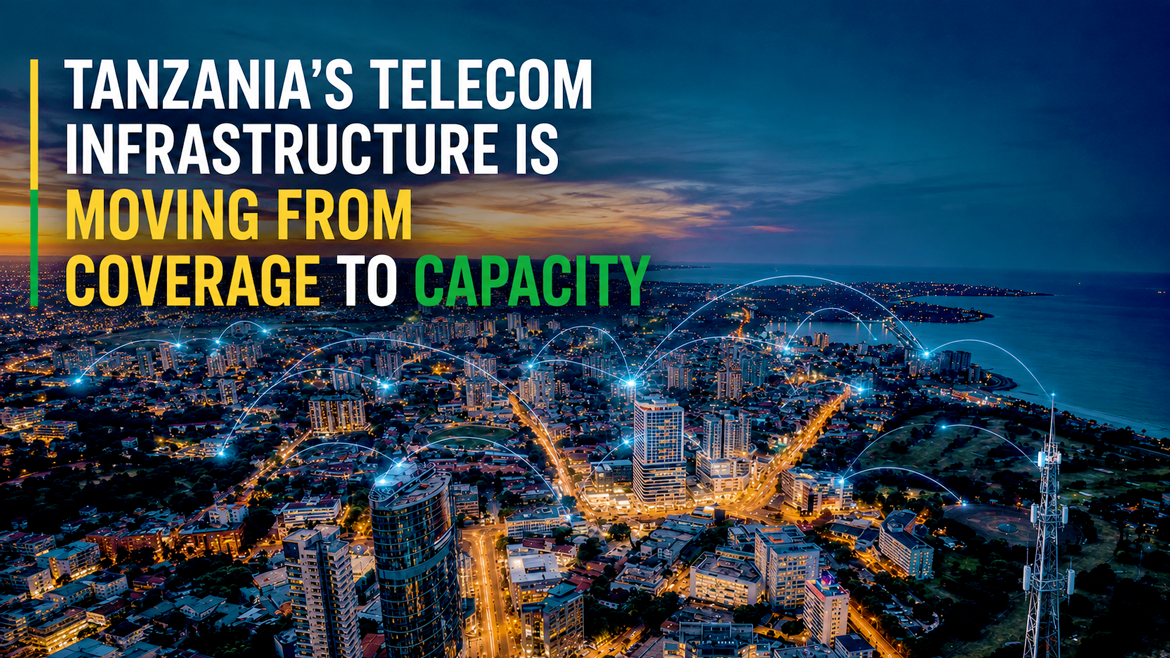
Nearly 10,000 towers and accelerating 5G deployment are strengthening the physical foundation for Tanzania’s digital economy
Tanzania entered the second half of 2026 with a telecommunications network increasingly capable of supporting mass connectivity, digital-service delivery and enterprise growth.
By June 2026, the country’s communications infrastructure included 9,933 telecom towers. These physical assets supported 15,992 2G base stations, 14,814 3G nodes, 15,697 4G sites and 1,958 5G sites, according to the Tanzania Communications Regulatory Authority (TCRA).
The numbers reveal more than the scale of the network. They show a sector operating across two development priorities: maintaining nationwide access while expanding the capacity required by a more data-intensive economy.
A network built for different levels of demand
Each technology layer continues to serve a distinct economic purpose.
The 15,992 2G base stations preserve basic voice, messaging and feature-phone connectivity. This remains important for communities and users who have not yet migrated to smartphones, particularly in areas where affordability and device access influence technology adoption.
Tanzania’s 14,814 3G nodes provide a broad bridge into mobile internet use. They support everyday digital activities such as messaging, web access, mobile applications and entry-level online services.
However, 4G has emerged as the country’s principal high-speed mobile platform. With 15,697 sites recorded by June 2026, the 4G network is approaching the scale of the country’s 2G infrastructure. This signals a decisive shift: mobile data is no longer an additional telecommunications service, it is becoming the core delivery channel.
The 1,958 operational 5G sites represent the next stage of that transition. Although the network remains smaller than the established technology layers, the number of 5G sites increased by 8.5% during the quarter ending June 2026.
That quarterly expansion is an important forward indicator. It suggests operators are beginning to add capacity for locations and customers whose requirements extend beyond conventional mobile broadband.
What the data is really signalling
Tanzania’s telecom story is moving from basic network presence toward network capability.
The first phase of communications expansion focused on connecting more people and extending services across a geographically large country. The emerging phase is about what those connections can carry: digital payments, cloud applications, video, remote services, enterprise systems and increasingly data-intensive public platforms.
The near parity between 2G base stations and 4G sites is particularly revealing. It shows that high-speed connectivity has moved much closer to the centre of Tanzania’s national communications architecture.
Meanwhile, the continued presence of extensive 2G and 3G infrastructure demonstrates that the transition is being layered rather than abrupt. Older technologies are maintaining inclusion while 4G and 5G expand the economy’s digital capacity.
These figures should not be interpreted as separate physical locations in every instance. A single telecom tower can host several technologies and equipment belonging to more than one operator. The technology-site counts therefore measure deployed network layers, while the 9,933 towers provide the clearest indication of the underlying physical footprint.
Why infrastructure readiness matters to investors
For investors, telecommunications infrastructure influences the cost and feasibility of entering almost every digitally enabled market.
A broad physical tower footprint can shorten deployment timelines and create opportunities for infrastructure sharing. Extensive 4G availability expands the addressable market for digital financial services, streaming, e-commerce, logistics platforms, online education and remote healthcare.
The developing 5G layer carries a different investment proposition. Its initial value is likely to be strongest in urban centres, industrial zones, commercial districts and institutions requiring greater speed, reliability or network capacity.
Potential applications include fixed wireless broadband, connected industrial operations, smart logistics, high-capacity business connectivity and advanced digital public services.
Infrastructure alone does not guarantee adoption. Commercial outcomes will also depend on smartphone affordability, data prices, electricity reliability, fibre backhaul, digital skills and the availability of locally relevant services. But network readiness removes one of the most significant constraints on digital investment.
From telecom assets to productive infrastructure
The next measure of progress will not simply be how many sites Tanzania adds. It will be how effectively that infrastructure is converted into economic activity.
That means using the network to help businesses reach customers, improve public-service delivery, connect underserved communities and enable enterprises to operate more efficiently.
With 9,933 towers, a mature 4G platform and a 5G network expanding by 8.5% in one quarter, Tanzania has established a substantial foundation. The strategic opportunity now is to turn that communications footprint into productive national infrastructure, one capable of carrying the next generation of investment, services and growth.
Source: Tanzania Communications Regulatory Authority, communications-sector data for the quarter ending June 2026.